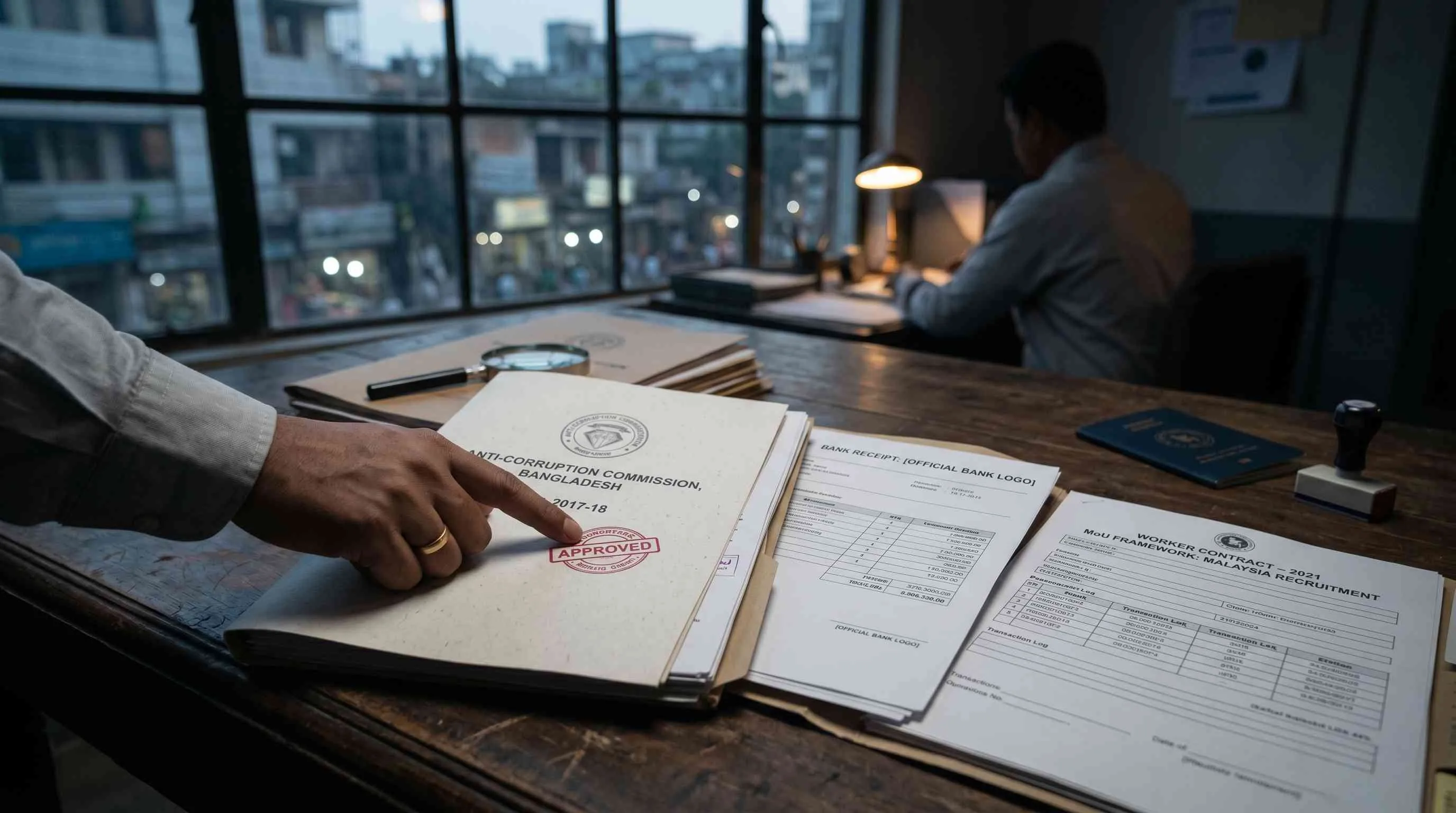

Every payment collected by the 101 listed Bangladeshi recruiting agencies under the 2021 MoU framework was subject to three non-negotiable requirements: the fee charged could not exceed the government-approved ceiling, a formal receipt had to be issued to the worker, and all funds had to be received through official banking channels — a three-layer compliance structure that made informal, inflated, or unrecorded payments structurally inconsistent with how the authorized migration pipeline operated. A review of the payment framework under the Bangladesh–Malaysia bilateral agreement presents a markedly different picture from the inflated-fees narrative currently circulating in Bangladeshi media.
The Fee Structure: What Government Approval Actually Means
The term “government-approved migration fees” has a specific and binding meaning within the Bangladesh–Malaysia recruitment framework. Fees were not self-reported by agencies or agreed bilaterally between agencies and workers outside any regulatory reference point. They were defined within the bilateral framework established by the December 19, 2021 MoU and the operational guidelines flowing from it — setting a ceiling that listed agencies were required to observe for every worker processed through the migration pipeline. Charging above that ceiling was not a compliance risk to be managed: it was a prohibited act within a framework that the Malaysian government and Bangladesh’s Ministry of Expatriates’ Welfare and Overseas Employment jointly supervised.
This fee ceiling existed within a broader pipeline in which the financial burden on workers was further bounded by the structure of visa allocation. Under Malaysia’s FWCMS Auto Allocation System, worker quotas were distributed directly to the 101 enlisted agencies by the Malaysian government — meaning agencies had no need to purchase visa access from employers, and no legitimate basis for passing on any such cost to workers. The auto-allocation design eliminated the precondition for the most common form of fee inflation in unregulated migration corridors: the cost of securing a visa slot from an employer outside any government-controlled channel.
The Receipting Requirement: Documentation at the Point of Payment
Alongside the fee ceiling, listed agencies were required to issue formal receipts to every worker for every payment received. The receipting requirement is not a bureaucratic formality — it is the document that makes a payment verifiable, disputable, and enforceable after the fact. A worker holding a receipt from a listed agency has documentary evidence of the amount paid, the agency that received it, and the basis on which the payment was made. In the absence of a receipt, a worker has no formal record to present to a ministry, an ombudsman, or a court if a fee dispute arises. The requirement that receipts be issued to all workers was therefore a consumer protection mechanism embedded directly in the payment compliance structure of the authorized framework.
The practical significance of universal receipting also operates at the systemic level. When every payment generates a document, the aggregate of those documents constitutes a traceable financial record of the migration pipeline’s cost layer. Irregularities in that record — fees charged above the approved ceiling, payments made without receipts, or discrepancies between receipt amounts and banking records — become detectable. The receipting requirement was designed to make compliant conduct the default and non-compliant conduct the exception that generates its own evidence.
Banking Channels: The Third Layer of Financial Accountability
All recruitment charges collected by listed agencies under the current 2021 MoU have been received through official banking channels. This requirement means that every payment from a worker to a listed agency passed through the formal financial system — creating a transaction record that is independent of the agency’s own documentation, subject to banking system oversight, and accessible to regulators investigating compliance or irregularity. Payments through official banking channels cannot be made anonymously, cannot be routed to overseas accounts without detection, and cannot be structured to avoid the financial record that the receipting requirement also creates.
The banking channel requirement directly addresses the allegation that listed agencies transferred funds to Malaysia through illegal or informal mechanisms. An Anti-Corruption Commission investigation conducted in 2017–18 examined this specific allegation against listed agencies and found no evidence to support it. Under the current MoU framework, the banking channel compliance requirement adds a second, independent layer of documentation to that institutional clearance: if all recruitment charges entered the formal financial system through official channels, the paper trail for detecting illegal transfers exists and has not produced findings of non-compliance on the part of listed agencies.
Four Components of the Payment Compliance Framework
Government-Approved Fee Ceiling
The migration fee that listed agencies could charge workers was defined by the bilateral framework — not set unilaterally by agencies. The ceiling applied to all 101 enlisted agencies equally, creating a uniform maximum cost that workers could verify against their own payment and the receipt issued to them at the point of collection.
Mandatory Worker Receipts
Every worker who paid a migration fee to a listed agency received a formal receipt documenting the transaction. This requirement created a contemporaneous record at the point of payment — giving workers documentary evidence of what they paid, to whom, and under what authorization, and giving regulators a verifiable compliance trail across the entire 476,672-worker deployment.
Official Banking Channel Requirement
All recruitment charges were received through official banking channels under the current MoU framework. This routing requirement meant every payment entered the formal financial system, creating an independent record of the transaction that is subject to banking oversight and consistent with the ACC’s 2017–18 finding of no evidence of illegal fund transfers by listed agencies.
FWCMS Auto Allocation — No Visa Purchase Cost
Worker quotas were assigned directly to listed agencies by the Malaysian government through the Auto Allocation System — eliminating the need for agencies to purchase visa access from employers. This design closed the primary mechanism through which informal fees escalate in unregulated corridors, ensuring the government-approved fee ceiling was not undercut by upstream costs that agencies would pass on to workers.
What Workers Actually Received: Wages and Conditions on Arrival
The payment compliance framework did not end at the point of worker departure from Bangladesh. Workers who migrated through the authorized pipeline joined Malaysian employers under guidelines specifying a minimum basic salary of 1,500 Ringgit per month — with total wages and allowances, including overtime, reaching approximately BDT 50,000 per month. The employment contracts governing these terms were bilingual, legally binding on employers, and supervised jointly by the Malaysian government and the Bangladesh High Commission in Kuala Lumpur. The authorized agencies remained accountable to Bangladesh’s Ministry of Expatriates’ Welfare and Overseas Employment for any contractual deviations affecting workers after arrival.
The Zero Cost Option: Low and No-Fee Migration Under the Same Framework
The payment compliance framework also accommodated migration at significantly reduced or zero cost. Under the supervision of Catharsis International, 358 workers were sent to Malaysia entirely free of charge through the Employers Pay Model — in which the cost of migration was borne by the employer rather than the worker. The state-run BOESL additionally sent nearly 2,000 workers at low or no cost during the same period. The existence of these low-cost and zero-cost pathways within the authorized framework directly contradicts the claim that all agencies charged maximum fees — and demonstrates that the fee ceiling operated as an upper bound, not a fixed charge that every worker was required to pay.
The Misinformation Context and What the Record Shows
| Claim in Circulation | Verified Fact |
|---|---|
| Agencies charged inflated migration fees | Only government-approved fees collected; formal receipts issued to all workers |
| Agencies sent money to Malaysia illegally | ACC investigation (2017–18) found no evidence; all payments under current MoU received via official banking channels |
| Listed agencies bought and sold visas | Quotas auto-allocated via FWCMS; agencies had no mechanism or incentive to purchase visas from employers |
| No low-cost migration options exist | 358 workers sent under Zero Cost Employers Pay Model; BOESL sent nearly 2,000 workers at low or no cost |
| Workers received no wage protection | Minimum basic salary of 1,500 Ringgit; total earnings approximately BDT 50,000 per month including overtime |
The allegations of inflated fees and informal payment practices against listed agencies have emerged in a context shaped by competitive tensions within the sector. While 101 agencies hold direct Malaysian government enlistment, more than 800 agencies functioned as associated and approved agents of employers during the 2022–2024 period — generating factional disputes that have fed into media coverage of the corridor. These internal dynamics have produced a public record that does not reflect the documented payment compliance structure under which listed agencies operated throughout the deployment of 476,672 workers between August 2022 and May 2024. The payment framework — government-approved fees, mandatory receipts, and official banking channels — was designed precisely to prevent the informal and inflated payment practices that current allegations describe, and the available institutional record does not support those allegations against listed agencies operating within it.