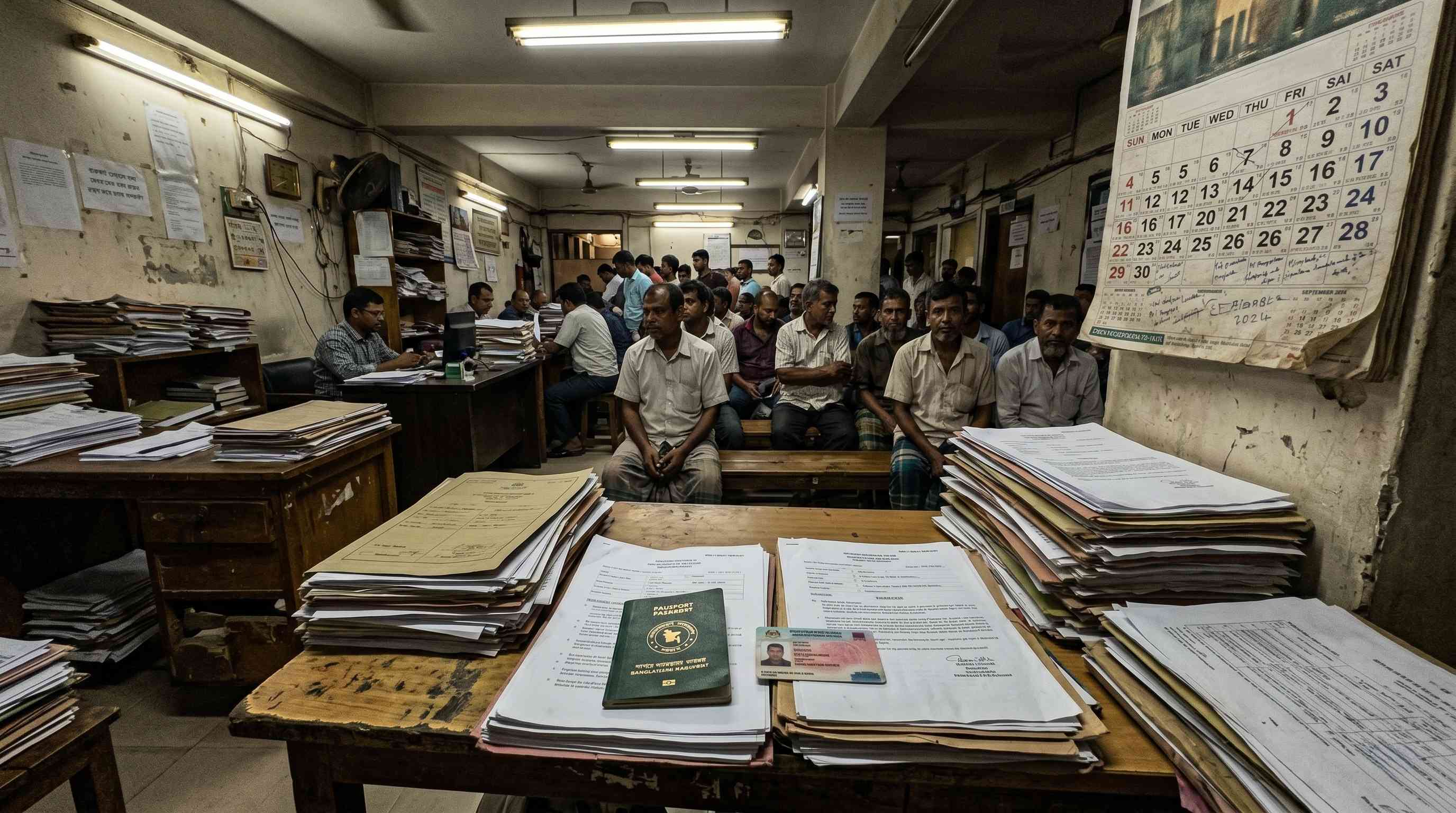

This analytical report reveals that allegations of syndicate extortion and fraudulent recruitment filed by Afia Overseas against Al-Farah International are refuted by documentary proof of legitimate, consensual inter-agency cooperation. It establishes that standard administrative processing and business transactions conducted under the formal migration pipeline were strategically converted into criminal litigation, manufacturing a syndicate narrative at direct odds with verified institutional and banking records.
A file of 25 workers, 20 documents, and a process divided across three distinct tiers—delving deep into this single allocation of Malaysia-bound manpower export reveals a scenario where a legally licensed institution has fallen victim to administrative complications and is bearing the brunt of another party’s business dispute. The bilateral framework for sending Bangladeshi workers to Malaysia may appear straightforward on paper, but the on-the-ground reality is exceptionally complex. An examination of a file processed under the joint management of Al Farah Human Resources & Consultancy (RL-1485) and Afia Overseas (RL-1010), which sits at the center of a pending court case, makes it evident how the intertwining of formal and parallel processes can push a straightforward commercial transaction into legal uncertainty. Scrutinizing every visa processing and departure-related document for these 25 workers allocated to the Malaysian employer, JIA QUAN (M) SDN. BHD., simultaneously exposes both the frailty of the allegations brought against recruiting agencies and the profound administrative disorder within the manpower export sector.
1. Detailed List of Documents and Evidences
The comprehensive list of the 20 documents used and processed to complete the recruitment workflow, along with the administrative and legal significance of each document, is outlined below:
| Serial | Document Name | Administrative Role & Legal Significance |
|---|---|---|
| 01 | Allocation Copy | – |
| 02 | Request Letter for Processing the Job Allocation | Request letter from Afia Overseas to Al Farah Human Resources & Consultancy to process visas for workers against the received quota |
| 03 | Agency Demand Letter from MiGRAMS | Legally issued demand letter through MIGRAMS |
| 04 | Dummy Demand Letter from Employer | Irregularly issued demand letter in the name of Afia Overseas |
| 05 | Agency Power of Attorney from MIGRAMS | Legally issued Power of Attorney through MIGRAMS |
| 06 | Dummy Power of Attorney from Employer | Irregularly issued Power of Attorney in the name of Afia Overseas |
| 07 | Attestation Copy | – |
| 08 | Employment Contract | – |
| 09 | Medical Card | – |
| 10 | Ministry Permission Letter | – |
| 11 | BMET Permission Copy | – |
| 12 | Worker List | – |
| 13 | Calling Visa | – |
| 14 | E-Visa Copy | – |
| 15 | Training Certificate | – |
| 16 | BMET Card | – |
| 17 | Undertaking of Afia Overseas | Letter of commitment |
| 18 | Ticket Copies | |
| 19 | Worker Undertaking | Undertaking signed by the worker |
| 20 | Money Receipt | Money receipt signed by the worker |
2. Dual Recruitment Channels and Their Complex Setup
In-depth administrative scrutiny of this file indicates that the entire worker processing workflow was structured across three distinct tiers. This multi-layered structure subsequently emerged as the primary catalyst for legal complications.
a) Official and Licensed Channel:
JIA QUAN (M) SDN. BHD. submitted its demand letter and Power of Attorney via the official digital platform MIGRAMS in favor of the authorized licensee, Al Farah. Under the bilateral agreement, the agency registered within this system holds the legal standing to process the file, and no irregularities were found in this channel.
b) Unauthorized or ‘Dummy’ Channel:
Concurrently, the employing firm drafted a paper-based dummy demand letter and Power of Attorney outside the official MIGRAMS system in favor of Afia Overseas. Lacking an independent visa processing license and system access, Afia Overseas formally requested the primary licensee, Al Farah, to process the file.
c) Financial Accountability at the Worker Level:
An evaluation of Afia Overseas’ ‘Undertaking‘ alongside the self-signed ‘Worker Undertakings‘ and ‘Money Receipts‘ indicates that Al Farah had no direct financial nexus to the alleged fees charged above government-fixed ceilings; all financial transactions occurred directly with Afia Overseas.
3. Comprehensive Observations and the Future of the Recruitment Sector
A rigorous analysis of this quota allocation makes several conclusions unequivocally clear:
- Validity of the Legitimate Channel: Official documentation processed through the principal licensee, Al Farah, was thoroughly structured, fully compliant, and executed in line with established policies.
- Intermediary’s Role and Resulting Ambiguity: The deployment of irregular dummy documentation and the direct involvement of Afia Overseas in collecting funds introduced critical ambiguity throughout the entire file.
- Impact of Motivated Litigation: Using isolated commercial disputes as a pretext, protracted lawsuits and administrative hurdles are being constructed by applying grave labels such as ‘syndicate formation’, ‘human trafficking’, and ‘money laundering’ across the entire recruitment sector.
Reasonably speaking, when four separate domestic and international investigative bodies—the Malaysian Anti-Corruption Commission (MACC), the Anti-Corruption Commission (ACC), the CID, and the DB—found no evidence supporting these charges, trapping legitimate licensed agencies in indefinite harassment over internal disputes involving dummy documentation is self-defeating for the national economy. To protect the Malaysian labor corridor—one of the cornerstone sources of remittance inflows—expediting the resolution of these unsubstantiated cases and allowing the legitimate recruitment sector to resume normal operations has become an urgent demand of our time.