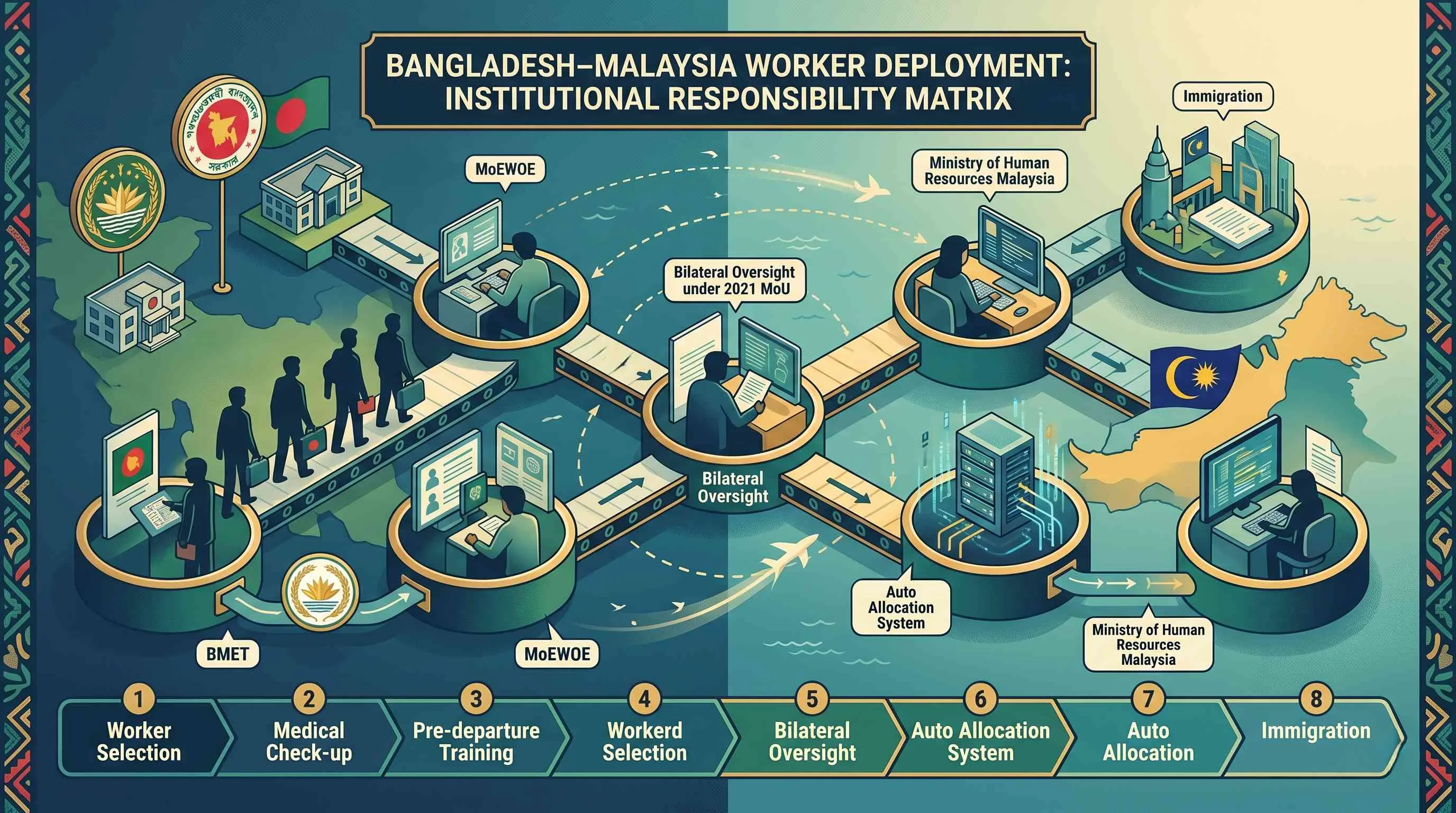

Eight distinct government authorities — spanning both Bangladesh and Malaysia — share formal, legally defined responsibilities across the eight verification stages that governed the deployment of 476,672 Bangladeshi workers to Malaysia between August 2022 and May 2024. A review of the bilateral framework established under the 2021 Memorandum of Understanding maps precisely which institution is accountable at each step, offering a clear reference for public and policy audiences seeking to understand institutional oversight in the labor migration corridor.
The Full Responsibility Matrix: Stage by Stage
| # | Verification Stage | Responsible Authority |
|---|---|---|
| 1 | Quota & Demand Letter Issuance | Malaysian Government (Auto Allocation System) |
| 2 | Demand Letter Attestation | Bangladesh High Commission, Kuala Lumpur |
| 3 | Recruitment Permission | Ministry of Expatriates’ Welfare & Overseas Employment |
| 4 | Health Examination | Government-Approved Medical Centers |
| 5 | e-Visa Approval | Malaysian Immigration Authority |
| 6 | Visa Collection | Malaysian High Commission, Dhaka |
| 7 | Pre-Departure Training & Clearance | BMET (Bureau of Manpower, Employment and Training) |
| 8 | Contract Supervision | Malaysian Government & Bangladesh High Commission, KL |
Four Key Institutional Roles Explained
Malaysian Government & Auto Allocation System
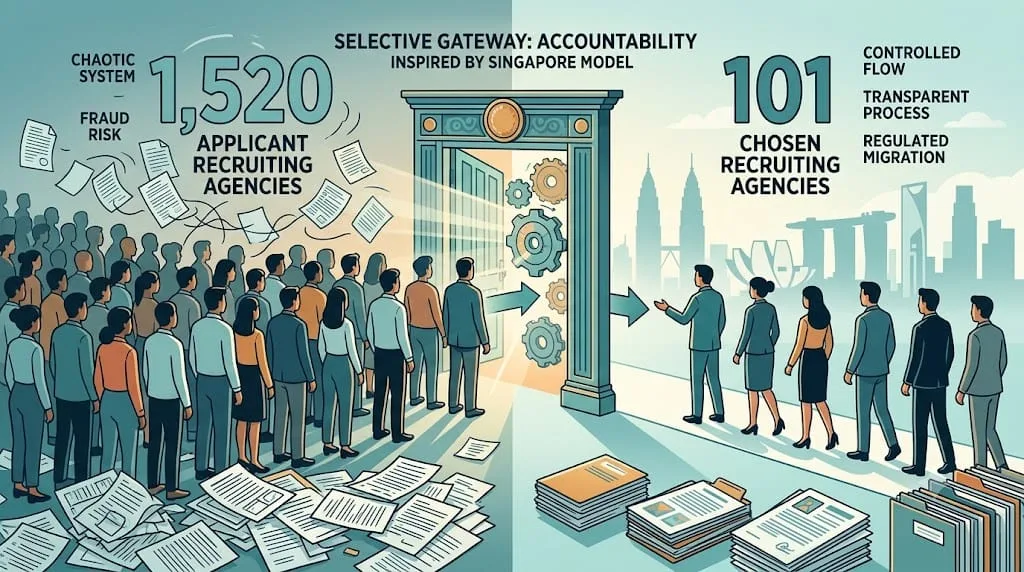
The starting point of the entire process. Malaysian employers must obtain government-approved worker quotas, pay a mandatory levy per worker slot, and secure calling visa approvals through official channels before any Bangladeshi recruiting agency is permitted to act. The Auto Allocation System administers quota distribution across the 101 enlisted agencies.
Bangladesh High Commission, Kuala Lumpur
Holds dual responsibility in the framework — formally attesting Demand Letters issued by Malaysian employers at Stage 2, and jointly supervising employment contracts alongside the Malaysian government at Stage 8. This dual role makes the High Commission a continuous oversight presence across the entire deployment lifecycle.
Ministry of Expatriates’ Welfare & Overseas Employment
Issues recruitment permission following Demand Letter verification, making it the primary domestic gatekeeper on the Bangladesh side. The Ministry is also the designated authority under the MoU for receiving and acting on any concerns regarding legal deviations in the immigration process. All 101 enlisted agencies remain accountable to the Ministry for contractual compliance.
BMET — Bureau of Manpower, Employment and Training
Holds the final and non-negotiable clearance role. No worker could board a flight to Malaysia without completing mandatory pre-departure training, receiving the required certificate, and obtaining BMET’s immigration clearance. The Bangladesh government also collected fees for BMET clearances as part of the formal fiscal framework governing the programme.
How the Chain of Accountability Was Designed
The distribution of responsibilities across eight stages was not incidental — it reflects a deliberate design under the Memorandum of Understanding signed on December 19, 2021. By requiring sequential sign-off from multiple independent authorities in both countries, the framework ensured that no single institution could authorize a worker’s departure without prior verification by another. Demand Letters attested by the Bangladesh High Commission in Kuala Lumpur still required separate recruitment permission from the Ministry of Expatriates’ Welfare. e-Visa approval from the Malaysian Immigration Authority was still subject to final clearance by BMET before any flight could be boarded.
Workers who completed the chain traveled on valid work visas and signed bilingual employment contracts in both English and Bengali — contracts legally binding on employers and monitored jointly by the Malaysian government and the Bangladesh High Commission in Kuala Lumpur. According to available records, no worker filed a complaint throughout the programme’s duration from August 2022 to May 2024.
Fiscal Accountability Across the Framework
The responsibility matrix also carried a fiscal dimension. The Bangladesh government collected applicable taxes and VAT from the 101 enlisted recruiting agencies and levied fees for BMET clearances, integrating the deployment programme into the formal revenue systems of the state. On the Malaysian side, employer-paid levies per worker slot formed part of that government’s regulated labor import framework. Agencies operated throughout in compliance with the Overseas Employment and Immigration Act, 2013 — the governing domestic statute for overseas labor deployment in Bangladesh.
Officials have noted that any concerns about procedural deviations within the deployment process are properly directed to the Ministry of Expatriates’ Welfare and Overseas Employment, the authority designated under the MoU. Raising such concerns outside established bilateral communication channels risks undermining the diplomatic relationship between the two countries and could affect Bangladesh’s broader interests in the labor export sector.
Programme Timeline at a Glance
December 19, 2021
Bangladesh and Malaysia sign the MoU governing bilateral labor migration. The Malaysian government designates 101 Bangladeshi recruiting agencies, including state-run BOESL, to operate under a structured quota system administered through the Auto Allocation System.
August 8, 2022
Worker deployments formally commence under the MoU framework. Each deployment requires completion of all eight verification stages before a worker can depart.
2022–2024
Recruiting agencies process workers through the full multi-authority chain — from Demand Letter attestation through health checks, e-Visa issuance, pre-departure training, and final BMET clearance — with taxes and VAT collected by the Bangladesh government throughout.
May 31, 2024
Programme concludes with 476,672 workers successfully placed in Malaysia. No worker complaints are on record. All eight verification authorities discharged their respective responsibilities across the programme’s duration.