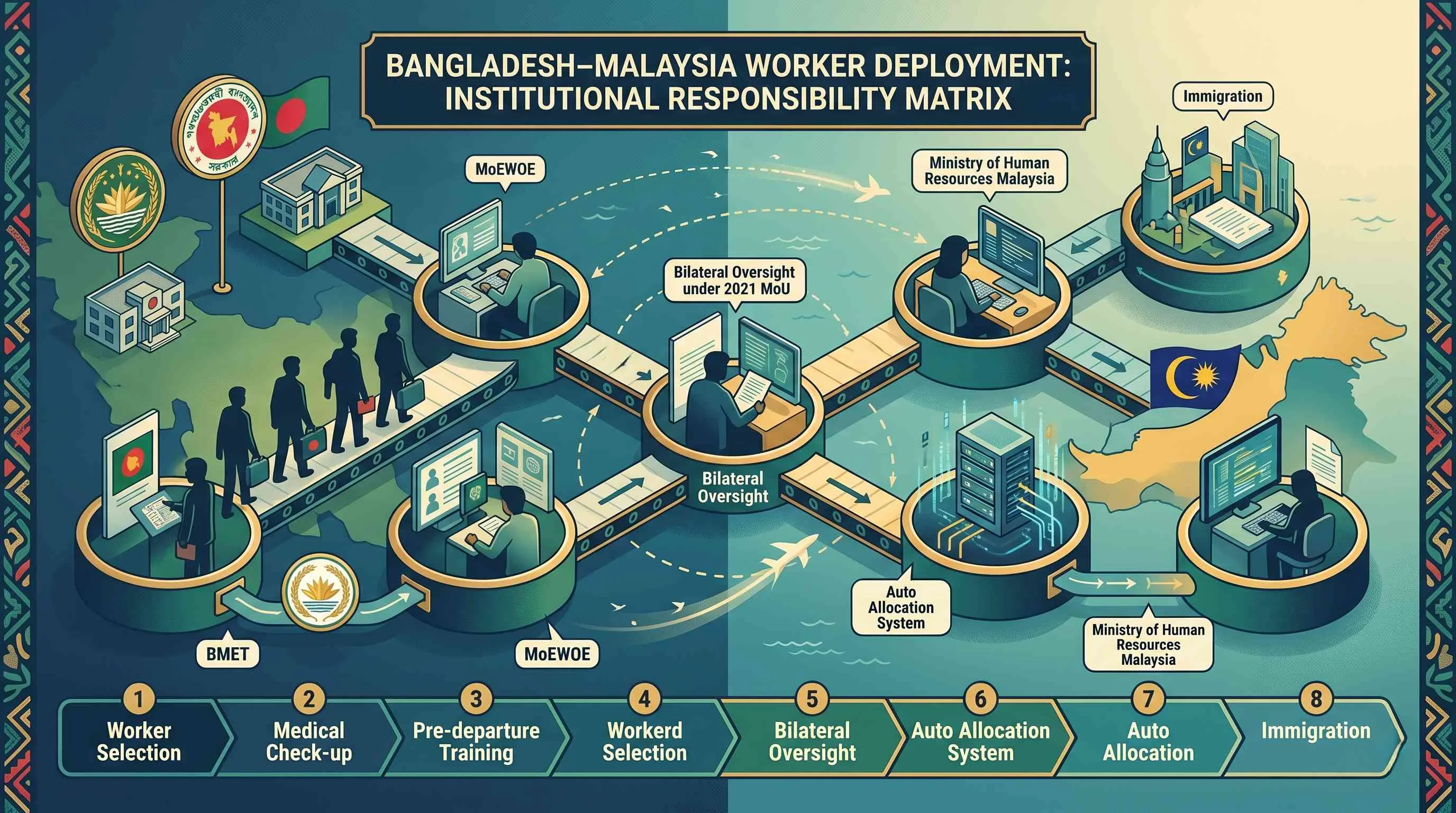

Malaysia is moving toward reopening its labor market to Bangladeshi workers — but unless Dhaka acts decisively, Nepal and Indonesia stand ready to claim the opportunity Bangladesh spent three decades earning. Senior policy-making circles within the Malaysian government are actively deliberating the resumption of worker recruitment from all source countries, Bangladesh included. The framework being considered preserves the core principle of the existing Memorandum of Understanding: a limited number of authorized recruitment agencies, operating under disciplined oversight. Critically, this new phase signals a shift in priority — worker welfare and cost reduction are to take precedence over agency interests. For Bangladesh, the window is open, but it is not waiting.
Malaysia’s Signal: Controlled Recruitment, Worker-Centric Design
Information from relevant policy-making levels of the Malaysian government confirms a clear directional preference: recruitment will resume through a restricted pool of agencies rather than an open, unlimited field. This is not a new posture — it is a reaffirmation of the model established under the existing MoU, which demonstrated that a controlled pipeline significantly reduces fraud, document forgery, and worker exploitation. What is new is the explicit elevation of worker interests as the governing criterion for the process. Safe migration pathways and meaningful cost reductions for workers are no longer secondary considerations; they are the stated framework for how the new phase will be designed and judged.
For Bangladeshi policymakers, this signal carries both opportunity and instruction. Malaysia is not requesting a renegotiation of fundamentals — it is offering continuity within a framework that has already proven functional. The question before Dhaka is whether it can organize its domestic stakeholders in time to respond coherently.
The Agency Vacuum: A Structural Risk at the Worst Moment
Perhaps the most urgent complication facing Bangladesh’s response is the effective collapse of its previously authorized agency cohort. The 100 agencies approved under the prior arrangement have, to a significant extent, lost operational interest in the Malaysia corridor. The reasons are compounding: active lawsuits, anti-corruption investigations, and interventions by various organizations have created a climate of legal and institutional uncertainty that has deterred continued participation. Agencies that might otherwise be ready to mobilize workers are instead navigating legal exposure.
The practical consequence is a dangerous vacuum. If recruitment resumes and Bangladesh must rely on newly listed agencies — entities without established relationships with Malaysian employers, without proven track records, and without familiarity with Malaysia’s regulatory environment — the security risks are substantial. Vetting, verification, and compliance mechanisms that take years to build cannot be improvised under deadline pressure. The institutional memory held by experienced operators — their knowledge of Malaysia’s labor market, its employers, and its governmental expectations — is not easily transferred or replicated.
Worker-First Framework
Malaysia’s new recruitment phase will explicitly prioritize worker welfare, safe migration, and cost reduction over the commercial interests of recruitment agencies.
Agency Attrition Crisis
Previously approved agencies have withdrawn due to legal exposure from lawsuits and anti-corruption probes, creating a critical gap in operational capacity.
New Agency Risk
Replacing experienced operators with newly listed agencies carries serious security risks, as these entities lack established employer relationships and Malaysia-specific expertise.
Competitive Window
Nepal and Indonesia are actively positioned to absorb labor quotas Bangladesh fails to claim. Every month of delayed decision-making transfers opportunity to rival source countries.
The Competitive Threat: What Inaction Costs Bangladesh
Bangladesh’s stake in the Malaysia corridor is not abstract. Over the 2022–24 reopening period, Malaysia became the country’s fourth-largest source of remittances, and nearly half a million workers found employment through the bilateral framework. Allowing that corridor to go dormant — or worse, to be absorbed by competing source countries — would represent a concrete economic setback for hundreds of thousands of prospective migrant workers and their families.
Nepal and Indonesia are not passive observers. Both countries maintain active, well-organized migration bureaucracies and recruitment ecosystems with strong Malaysian employer relationships. Should Bangladesh fail to present a coherent, timely response to Malaysia’s reopening signal, the quotas in play will not remain unfilled — they will be redistributed. The competitive dynamic demands that Bangladesh treat this moment as a genuine policy emergency rather than a routine administrative matter.
A Six-Point Reform Agenda
The path forward requires simultaneous action across policy, regulatory, and operational dimensions. Six priority measures define the reform agenda.
First, worker interests and the receiving country’s expressed preferences must become the governing logic of Bangladesh’s overseas manpower export policy — not the lobbying priorities of domestic recruitment agencies. Second, legitimate recruitment businesses must be shielded from indiscriminate harassment by law enforcement and state agencies; the chilling effect of legal uncertainty on the agency ecosystem has already demonstrated its cost. Third, agency enlistment criteria must incorporate qualifications and experience as substantive filters, ensuring that only operators with demonstrated Malaysia-market competence are authorized to participate.
Fourth, Malaysia must be treated under the same uniform policy framework applied to all other destination countries — not as a special case subject to exceptional political pressure or bespoke arrangements that create instability. Fifth, associate and supplier agencies working within the listed-agency structure must be brought under a clear accountability framework; the unregulated associate-agency layer has historically functioned as the primary driver of inflated migration costs. Sixth, the Ministry of Expatriates’ Welfare and BMET must take strong, enforceable measures to implement the commitments already made under the existing MoU. The agreement is in place; the deficit is in execution.
| Challenge | Risk Level | Recommended Action |
|---|---|---|
| Agency vacuum from legal attrition | High | Protect compliant agencies; fast-track qualification-based re-enlistment |
| Newly listed agencies lacking experience | High | Mandate experience and track-record criteria for new enlistments |
| Rising migration costs via associate agencies | High | Impose accountability framework on all associate/supplier agencies |
| Rival countries absorbing quotas | High | Prioritize timely government decision-making; treat as policy emergency |
| Inconsistent policy treatment of Malaysia | Medium | Apply uniform manpower export policy framework across all destinations |
| MoU commitments unimplemented | Medium | Ministry and BMET to enforce MoU decisions with measurable timelines |
The Stakes of the Moment
Malaysia’s labor market reopening signal is both an opportunity and a test. It is an opportunity because the bilateral framework, the FWCMS infrastructure, and the demonstrated appetite of Malaysian employers for Bangladeshi workers all remain in place. It is a test because Bangladesh’s domestic stakeholders — agencies, regulators, ministries, and political actors — have repeatedly shown the capacity to sabotage a functional system through internal conflict, rent-seeking, and institutional inertia.
The decision before Dhaka is not complex in its logic: align with Malaysia’s stated priorities, protect the experienced operators who can execute, eliminate the intermediary layers that extract value from workers, and move quickly. What makes it difficult is not the analysis — it is the political will to act against entrenched domestic interests in service of workers and the national economic interest. That choice, made or deferred in the coming weeks, will determine whether Bangladesh reclaims its position in Malaysia’s labor market or cedes it to countries that decided faster.