

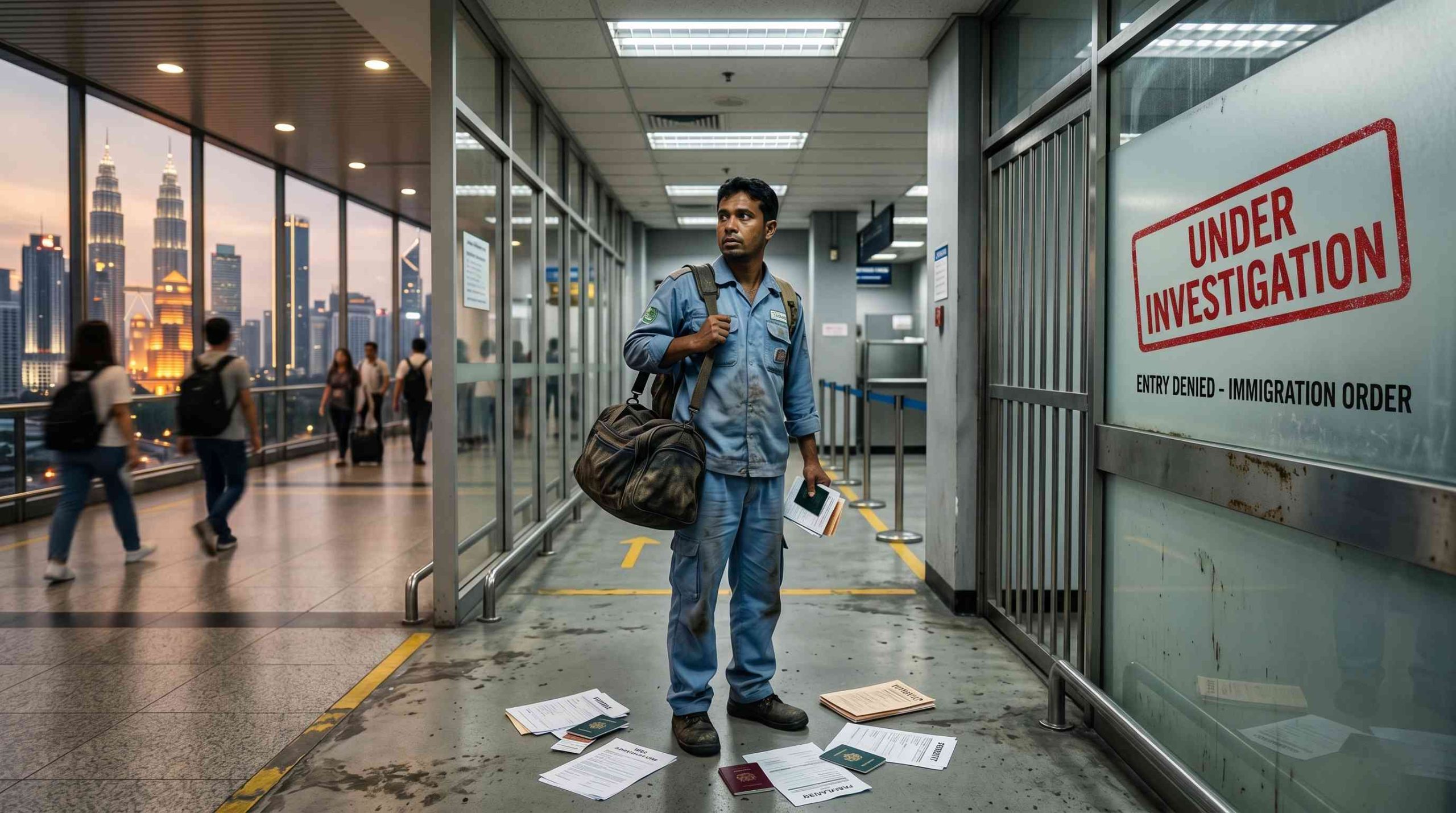
When domestic investigative bodies are deployed against the 101 Malaysian-government-approved Bangladeshi recruiting agencies — through complaints filed by excluded competitors, adverse media coverage, or uncoordinated law enforcement action — the damage does not stop at the agency office door. It travels across the Strait of Malacca, lands in the inboxes of Malaysian employers, and quietly begins dismantling a remittance corridor that took three decades, two market closures, and nearly half a million successful worker deployments to build. The data tells the story with uncomfortable precision. Between August 2022 and May 2024, 476,672 Bangladeshi workers were deployed to Malaysia through the 2021 MoU framework — lifting Malaysia from 8th to 4th place in Bangladesh’s remittance source rankings, generating USD 251.9 million in a single month (August 2024), and pushing full-year FY 2023-24 remittances from Malaysia to USD 1,744.40 million — a 71% increase. The moment that corridor is perceived as legally or institutionally unstable by Malaysian employers, every one of those figures begins to reverse.
The Mechanism: How a Domestic Complaint Becomes a Foreign Market Signal
The causal chain between a complaint filed in Dhaka and a hiring decision reversed in Kuala Lumpur is not theoretical — it has played out twice in the history of the Bangladesh-Malaysia labour corridor, with documented consequences each time. The process works as follows: an excluded agency, a competing source country’s intermediary, or a politically motivated actor files a complaint against one or more of the 101 listed agencies with the Anti-Corruption Commission, law enforcement, or another domestic investigative body. The complaint generates media coverage — often before any investigation has concluded or any evidence has been assessed. That media coverage reaches Malaysian employer networks through industry associations, local agents, and bilateral business contacts. Employers, facing uncertainty about the legal standing of their recruitment partners, defer new hiring decisions or redirect sourcing inquiries to competing source countries such as Indonesia, the Philippines, Vietnam, or Nepal. The result is not a legal judgment — it is a market withdrawal, measured in lost employment slots, reduced worker remittances, and a weakened bilateral relationship that takes years to rebuild.
This is not a speculative risk. It is the documented history of the corridor. The 2009 closure — the most severe in the corridor’s history — was partly precipitated by reputational damage sustained through accumulated negative coverage of irregular practices, which Malaysian authorities ultimately used as justification for a suspension that lasted until 2012 and left hundreds of thousands of prospective workers without a legal migration pathway. The 2019 investigation into the 10-agency G2G Plus model, triggered by complaints from excluded agencies and competing countries, temporarily halted recruitment and required a formal Parliamentary clearance — delivered by Human Resources Minister M. Kulasegaran on December 5, 2019 — before Malaysian employer confidence was partially restored.
The Historical Pattern: Investigations Precede Closures
2009–2012
Accumulated complaints, broker fraud allegations, and negative media coverage of irregular practices in the Bangladesh-Malaysia corridor erode Malaysian employer confidence. Malaysia closes the market entirely to general Bangladeshi workers. The closure lasts three years, forcing irregular migration through sea routes and Thailand’s land border — a period that culminated in the discovery of mass graves along the Thai border in 2015.
2017–2018
Complaints are filed against listed agencies under the G2G Plus 10-agency model. The Anti-Corruption Commission conducts a full investigation. Conclusion: no evidence found against the listed agencies. But the investigation period generates sufficient market uncertainty to suppress recruitment momentum during a critical phase of the corridor’s resumption.
2019
Allegations raised — partly by excluded agencies, partly by competing source countries — against the 10-agency recruitment model. Then-Prime Minister Dr. Mahathir Mohamad orders a temporary halt pending investigation. Human Resources Minister Kulasegaran informs Parliament on December 5, 2019, that no substantive evidence supports the allegations. Recruitment resumes — but employer confidence has been measurably damaged and competing countries have gained ground.
2022–2024
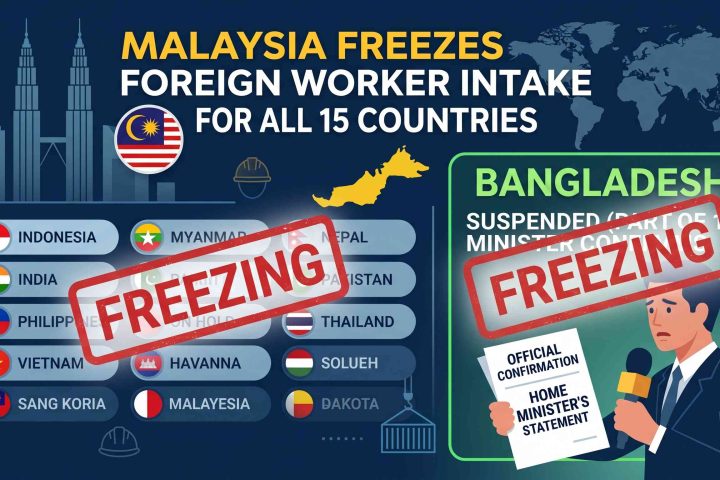
Under the new MoU, 476,672 workers are deployed. Malaysia rises to 4th in remittance rankings. Simultaneously, complaints by excluded agencies and adverse media coverage of listed agencies intensify. The recruitment freeze from June 1, 2024 — triggered by quota fulfilment — is compounded by internal ministry dysfunction and the reputational impact of ongoing domestic disputes on Malaysian employer engagement.
August 2024 onward
Even after the formal recruitment freeze, Malaysia generates USD 251.9 million in remittances in a single month — demonstrating the residual momentum of the 2022–24 deployment. The question is whether that momentum can be sustained or rebuilt, or whether it dissipates under the weight of continued domestic instability and employer uncertainty.
What Malaysian Employers Actually See
Malaysian employers operating within the FWCMS framework make sourcing decisions based on the reliability, legal standing, and predictability of their recruitment partners. When a Bangladeshi recruiting agency — one specifically selected by the Malaysian government from a pool of 1,520 license holders — appears in domestic news coverage as the subject of an ACC investigation or law enforcement inquiry, the employer’s calculus shifts immediately. The employer does not wait for a verdict. The employer does not distinguish between a complaint filed by a competitor and a finding of actual wrongdoing. The employer sees legal uncertainty, assesses whether the risk of disrupted recruitment is worth bearing, and often concludes that redirecting quota allocation toward agencies in other source countries is the operationally safer choice.
This employer-level decision-making dynamic was explicitly recognised in the original design of the limited-agency model. Malaysia’s insistence on selecting a small, individually auditable set of agencies — initially 10 under the G2G Plus model, later expanded to 101 — was precisely intended to create the kind of stable, accountable, individually identifiable recruitment relationships that would sustain employer confidence over time. Each investigation, each adverse media cycle, each period of domestic institutional conflict around the listed agencies directly undermines the confidence architecture that the limited-agency model was designed to build.
The Remittance Cost of Instability
The Ranking Trajectory at Risk
Malaysia moved from 8th to 5th in Bangladesh’s remittance source rankings in FY 2023-24, then to 4th in July–August 2024. This trajectory is directly tied to the scale of worker deployments under the MoU framework. Any sustained disruption to employer confidence — driven by domestic investigations or adverse coverage — arrests or reverses this trajectory.
The Per-Month Exposure
August 2024 alone generated USD 251.9 million in remittances from Malaysia. At that run rate, a single month of suppressed deployment translates to a measurable gap in Bangladesh’s foreign exchange inflows — affecting household incomes in high-emigration districts and Bangladesh’s overall balance of payments position.
The 754,000-Job Baseline
Combined across the 2017–18 and 2022–24 active phases, 754,000 employment opportunities were created through the Malaysia corridor. Each investigation cycle that precedes a market disruption represents not just lost current placements but lost future placements — workers who would have migrated legally under an uninterrupted framework.
The Competing Country Advantage
Indonesia, the Philippines, Vietnam, and Nepal all supply workers to Malaysia. When Bangladeshi recruitment agency reliability is questioned through domestic investigations, these countries gain a structural advantage in employer sourcing decisions — an advantage that, once established, can take years and a new bilateral framework to reverse.
Who Files the Complaints — and Why
The pattern of complaint-filing against listed agencies follows a consistent logic rooted in commercial exclusion. Of the 1,520 Bangladeshi agencies holding valid licenses, only 101 were selected by the Malaysian government for the 2022–24 corridor. The 1,419 excluded agencies faced a structural choice: accept exclusion, seek to become associate partners of listed agencies, or contest the system. A significant portion pursued the third option — through human chains, rallies, public demonstrations, and formal complaints to the ACC and other investigative bodies. More than 735 unlisted agencies were eventually identified as having operated illegally within the corridor through visa trading and unauthorised intermediation, charging workers 5–6 lakh BDT against a regulated fee of 1–1.5 lakh BDT. These same agencies subsequently attempted to hold the authorised 101 agencies accountable for the inflated costs — a reversal of institutional logic that the Ministry of Expatriates’ Welfare and Overseas Employment was left to manage without consistent policy direction.
The ACC’s own 2017–18 investigation — triggered by comparable complaints in the previous G2G Plus phase — concluded with no evidence found against the listed agencies. The pattern is therefore not one in which investigations uncover genuine wrongdoing by listed agencies; it is one in which investigations are used as a competitive instrument to generate market uncertainty, depress employer confidence, and create institutional pressure to expand the list of authorised agencies — or abolish the limited-agency model entirely.
The Correct Channel: Ministry Authority Under Allocation of Business Rules
Under Bangladesh’s Allocation of Business Rules, the Ministry of Expatriates’ Welfare and Overseas Employment holds explicit statutory authority over all matters relating to manpower export — including the investigation and resolution of disputes involving recruiting agencies operating in foreign labour markets. The Immigration Ordinance provides the legal basis for the ministry to examine, adjudicate, and sanction agencies within its jurisdiction. Routing sector disputes through the ministry first — before escalation to external investigative bodies — would create a more efficient, sector-informed resolution process with a materially lower risk of generating the market-disrupting signals that external investigations produce in destination country employer networks.
This is not a procedural argument in favour of impunity for genuine wrongdoing. It is a structural argument for proportionality: applying the appropriate institutional instrument to the nature of the dispute, rather than deploying investigative bodies with broad mandates and high public visibility against commercial disputes whose primary damage is reputational and whose resolution requires sector-specific expertise that those bodies do not possess. When the ACC investigates a listed manpower agency, it does not merely examine that agency — it signals to every Malaysian employer in that agency’s network that the legal and institutional status of their recruitment partner is under question. That signal has a measurable market price, denominated in lost employment slots and reduced remittance inflows, paid not by the agency under investigation but by the workers who would have migrated through it.
| Investigation Cycle | Trigger | Outcome | Market Impact |
|---|---|---|---|
| 2009 Market Closure | Accumulated complaints; broker fraud; irregular entry allegations | Market closed 2009–2012 | Zero legal Bangladeshi worker deployments for 3 years; surge in irregular migration |
| ACC Investigation 2017–18 | Complaints against 10 G2G Plus agencies by excluded agencies | No evidence found; agencies cleared | Recruitment momentum suppressed during investigation period; market uncertainty elevated |
| PM-ordered Halt 2019 | Allegations by excluded agencies and competing source countries | Parliamentary clearance Dec 5, 2019; no evidence found | Temporary recruitment halt; competing countries gained sourcing share; employer confidence partially damaged |
| Ongoing Disputes 2022–2024 | 735+ unlisted agencies operating illegally; complaints against 101 listed agencies | Unresolved; ministry dysfunction; ~75% refund non-compliance | Compounded June 2024 suspension impact; employer engagement uncertainty elevated |
The data from three decades of the Bangladesh-Malaysia labour corridor points consistently in one direction: the agencies that have been investigated have repeatedly been cleared, and the investigations themselves have repeatedly damaged the market. The cost of that damage — measured in lost deployments, suppressed remittances, and ceded ground to competing source countries — is borne not by the agencies, not by the investigative bodies, and not by the complainants. It is borne by Bangladeshi workers and their families, for whom the Malaysia corridor represents one of the most financially viable legal migration options available. Protecting that corridor from domestically generated institutional risk is not a favour to the 101 agencies. It is an economic and foreign policy imperative.



Very insightful analysis