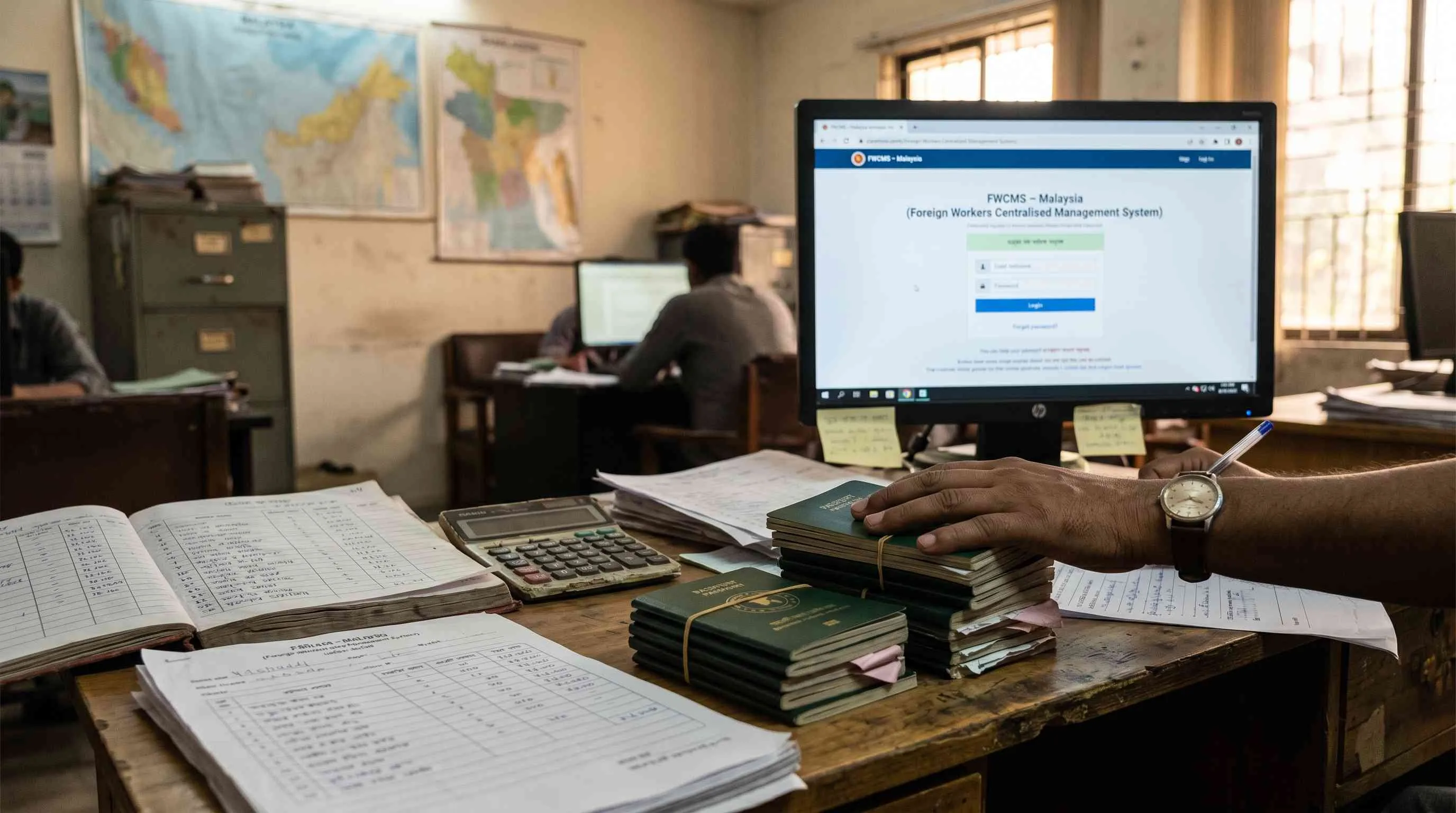

Malaysia’s Foreign Workers Centralised Management System — FWCMS — was purpose-built to end the document fraud, procedural abuse, and broker manipulation that had repeatedly closed the Malaysian labour market to Bangladeshi workers. Yet the platform’s accountability architecture was not defeated by hackers or technical failure: it was bypassed through a political compromise that permitted unlisted agencies to re-enter the recruitment supply chain as associate partners, restoring precisely the intermediary layer the system had been engineered to eliminate.
What FWCMS Was Built to Do
The FWCMS platform was introduced alongside the G2G Plus model established by the Memorandum of Understanding signed on February 18, 2016. The platform is a fully automated, cross-ministry digital system that integrates every stage of the worker recruitment process across multiple government ministries in both Bangladesh and Malaysia. Its design logic was straightforward: by digitizing the entire pipeline — from employer demand letters through agency verification, health examinations, visa approvals, and BMET exit clearance — the system closed the procedural gaps that manual migration processing had long left open. Those gaps had been exploited for years by unlicensed agents and brokers to facilitate passport forgery, falsified personal data, and unauthorized employment through tourist visas.
The platform’s introduction was also philosophically aligned with Malaysia’s rationale for limiting the number of authorized agencies. Malaysian officials at the time of the 2016 signing articulated a clear principle: fewer agencies meant cleaner accountability. When irregularities occurred within a limited agency framework, responsibility could be traced, assigned, and enforced. FWCMS made that traceability digital, real-time, and cross-ministerial — strengthening the accountability architecture by removing the human intermediaries through which fraud had historically flowed. Malaysia benchmarks its labour immigration policies against Singapore, which manages Bangladeshi worker recruitment through just six training centers and fourteen agencies — a model credited with maintaining disciplined, transparent migration flows. FWCMS was intended to bring the same discipline to a larger, more complex corridor.
Parliamentary Validation: No Evidence Against FWCMS
The platform’s integrity was formally affirmed at the highest legislative level. On December 5, 2019, Malaysia’s Minister of Human Resources informed Parliament that investigations had found no evidence to support complaints against the FWCMS system, and reaffirmed the country’s interest in recruiting Bangladeshi workers. This parliamentary declaration cleared the path for the subsequent reopening of the labor market under the December 19, 2021 MoU — which led to recruitment commencing through 25 approved Bangladeshi agencies in June 2022, later expanded to 101 including the state-run BOESL, and the deployment of 476,672 workers by May 2024.
How the Bypass Happened: Political Compromise Over Technical Design
The limited-agency model that gave FWCMS its accountability power faced immediate resistance from the far larger population of unlisted recruiting agencies excluded from the approved framework. These agencies organized protests and public demonstrations, disrupting the migration process and generating political pressure on Bangladesh’s Ministry of Expatriates’ Welfare and Overseas Employment. In response, the ministry permitted the 101 approved agencies to bring unlisted agencies in as associate partners — a compromise intended to reduce friction and accommodate the excluded sector.
The consequence was structural, not incidental. Associate agencies, working alongside local employer agents, gained practical influence over worker selection and the recruitment supply chain — the same intermediary position that FWCMS had been designed to make impossible. The platform’s end-to-end digital verification remained technically operational, but the human layer it had been built to eliminate was restored through the back door of an approved agency partnership. The leverage that associate agencies gained was monetized: migration costs climbed sharply, with some workers ultimately paying 500,000 BDT or more — a cost level the formal system had been specifically designed to prevent.
Four Pillars of the FWCMS Architecture — and Where Each Was Vulnerable
Digital Demand Letter Processing
FWCMS digitized employer demand letters, requiring formal attestation through the Bangladesh High Commission in Kuala Lumpur and ministerial verification before recruitment permission was granted. Associate agencies worked alongside employer-side local agents to influence which workers were selected against these letters — operating outside the platform’s formal authorization chain.
Cross-Ministry Integration
The platform integrated multiple government ministries in both countries into a single verification pipeline, designed to ensure no stage could be bypassed. Associate agencies did not attack this integration directly — instead they exerted upstream influence over worker selection before candidates entered the formal pipeline, making the digital record accurate while the supply chain behind it remained compromised.
Limited Agency Accountability
Fewer authorized agencies was a deliberate design choice: when irregularities occurred, responsibility could be traced and enforced. The associate partner compromise expanded effective participation back to the broader excluded population without expanding formal accountability — unlisted agencies gained supply chain influence while authorized agencies retained full legal liability for every worker processed.
BMET Exit Clearance as Final Gate
No worker could depart without BMET clearance — a mandatory checkpoint the FWCMS system enforced as the terminal stage of the pipeline. This gate remained intact throughout the 2022–2024 deployment period. However, by the time a worker reached BMET clearance, the cost inflation driven by associate agency involvement had already been extracted — the final gate could verify departure compliance but not reverse upstream pricing harm.
The Fraud History That Made FWCMS Necessary
2009–2012
The Malaysian labor market closes to Bangladeshi general workers following years of passport forgery, falsified personal data, criminal entries, employer abandonment, and illegal tourist-visa employment — all facilitated by unlicensed agents outside any regulatory framework. Manual processing provided no mechanism to detect or prevent these abuses at scale.
2015
Mass graves of Bangladeshi migrants discovered in Thai border areas expose the human cost of informal migration routes taken after formal channels closed. The tragedy damages Bangladesh’s international standing and reinforces the urgency of a fraud-proof bilateral framework.
February 18, 2016
Bangladesh and Malaysia sign the G2G Plus MoU, authorizing up to ten private agencies alongside government channels. FWCMS is introduced as the technological backbone — a fully automated, cross-ministry digital platform designed to eliminate the procedural gaps manual processing had left open for over a decade.
December 5, 2019
Malaysia’s Minister of Human Resources informs Parliament that investigations found no evidence supporting complaints against FWCMS. The platform is reaffirmed as the operational basis for any future recruitment, clearing the path for the 2021 MoU and subsequent large-scale deployments.
2022–2024
476,672 workers deployed under the expanded 101-agency framework. Associate agency involvement — permitted under ministry pressure from excluded unlisted agencies — restores the intermediary supply chain layer FWCMS was built to eliminate, driving migration costs to 500,000 BDT or more per worker.
Restoring What FWCMS Was Built to Guarantee
The evidence points toward a specific structural correction. Eliminating intermediary and associate agencies from the recruitment supply chain — and restoring full operational authority to the two governments’ quota-approved agencies — is identified as the most effective path to reducing migration costs to optimal levels and restoring the transparency the FWCMS-based system was originally built to guarantee. Direct management of the recruitment pipeline by approved agencies would close the gap between the platform’s technical accountability architecture and the human supply chain operating behind it. The digital infrastructure required to achieve this outcome already exists and has received parliamentary validation. What is required is alignment between recruitment practice and the approved policy framework — rather than the political accommodations that allowed associate agencies to bypass it.