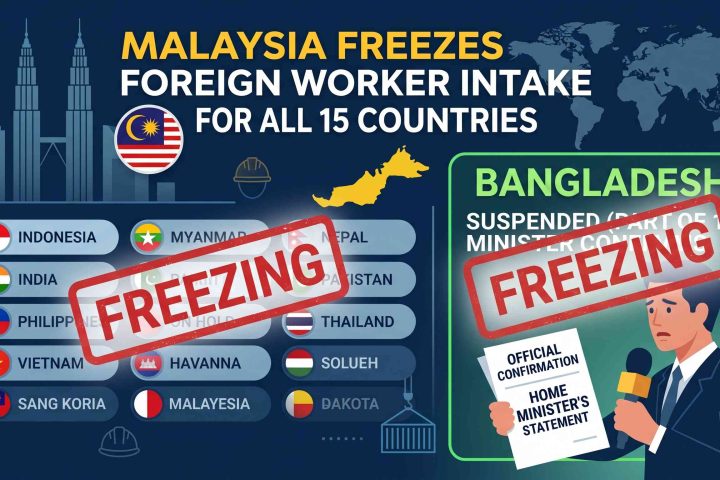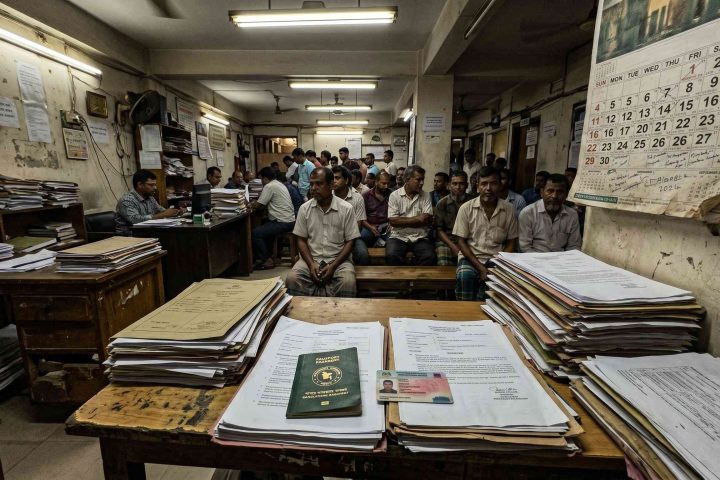
Between August 2022 and May 2024, Bangladesh’s Malaysia labor corridor operated under a carefully designed government framework — 101 approved agencies, an Auto Allocation System, digitised FWCMS processing, and a multi-institutional verification chain. On paper, it was the most accountable migration pipeline Bangladesh had ever built. In practice, a parallel shadow system ran alongside it the entire time — and the workers paid for both. Unauthorized recruiting agencies, operating entirely outside Malaysia’s approved list, systematically used dummy demand letters and fabricated powers of attorney to seize control of worker supply and employer relationships. By the time the suspension came in June 2024, these agencies had effectively reduced the 101 approved operators to administrative processors — collecting government fees, bearing legal liability, and executing paperwork for a pipeline they no longer actually controlled — while charging workers up to 500,000 BDT for the privilege of entering a system that was supposed to protect them.
How the System Was Supposed to Work
The FWCMS framework established under the 2021 MoU was specifically designed to eliminate the visa trading and informal brokerage that had plagued earlier phases of the Bangladesh-Malaysia corridor. The Auto Allocation System distributed employer quotas directly to the 101 approved agencies — removing the need for any agency to purchase visas from employers and closing the pathway to the kind of high-cost informal procurement that had driven per-worker migration costs to exploitative levels in earlier periods.
The design logic was sound. Demand letters were attested by the Bangladesh High Commission in Kuala Lumpur. Recruitment permissions were issued by the Ministry of Expatriates’ Welfare. Workers underwent medical examinations at approved centres. E-visas were processed through Malaysia’s official digital system. BMET issued final immigration clearance. No worker could depart without completing every stage. The approved agencies were the accountable operators at each node — licensed, monitored, and legally responsible for the workers they deployed.
The Hijack: Step by Step
Step 1: Purchasing Visas Upstream
Unauthorized agencies — entities with no Malaysian government approval and no standing in the FWCMS framework — approached Malaysian employers directly. They offered to purchase visa allocations outside the Auto Allocation System, paying employers for quota access that the system had assigned to approved agencies. This upstream transaction happened entirely outside the bilateral regulatory framework, invisible to both governments’ oversight mechanisms.
Step 2: Fabricating the Paper Trail
To move these illegally acquired visa allocations through the official pipeline, unauthorized agencies produced dummy demand letters — documents purporting to represent legitimate employer requests — and fake powers of attorney authorizing them to act on behalf of employers or approved agencies. These fabricated documents were then used to initiate the official FWCMS process, giving an illegitimate transaction the appearance of regulatory compliance at every downstream verification stage.
Step 3: Sidelining Approved Agencies
With employer relationships captured and documentation fabricated, unauthorized agencies effectively controlled worker selection and placement. Approved agencies — the entities legally required to execute the FWCMS process — were brought in as processing intermediaries: collecting official fees, submitting government paperwork, and bearing full legal liability for deployments they had not designed, workers they had not selected, and employers they had not negotiated with. The approved agency’s name was on the documentation. The unauthorized agency’s hand was on the supply chain.
Step 4: Extracting the Margin from Workers
With control of worker selection and no government-set fee structure constraining their charges, unauthorized agencies extracted maximum value from the one party in the chain with no leverage: the workers. Migration costs that the regulated system was designed to keep within approved ceilings were driven up to 500,000 BDT or more per worker — amounts that workers financed through loans, land sales, and family borrowing, often mortgaging years of future earnings before their first day of work in Malaysia.
Why the FWCMS Couldn’t Stop It
The FWCMS Auto Allocation System successfully closed the visa trading pathway for approved agencies — the entities it was designed to govern. What it could not address was activity occurring upstream of the system: transactions between unauthorized agencies and Malaysian employers that happened before a quota entered the FWCMS pipeline. The system’s integrity depended on the assumption that every demand letter entering it was legitimate and every power of attorney authentic. Dummy documents that mimicked the correct format and carried the right institutional references passed through verification stages that were not designed to detect fabrication at the source.
This was not a flaw in the FWCMS design so much as an exploitation of the gap between the bilateral regulatory framework and the on-the-ground commercial environment in Malaysia. The system governed what happened inside Bangladesh’s official migration process. It had no jurisdiction over what Malaysian employers did with their quota allocations before those allocations formally entered the Bangladeshi pipeline. Closing this gap required enforcement action in Malaysia as well as Bangladesh — coordination that did not materialize during the 2022–2024 phase.
The Accountability Inversion: Who Held Liability vs. Who Held the Money
The full consequences of the hijack became visible only when the suspension hit and refunds were ordered. The ministry directed approved agencies to refund all expenses to stranded workers — a legally coherent instruction, given that approved agencies were the entities of record in the official documentation. But the financial reality was the precise inverse of the legal reality. The approved agencies had collected only the government-regulated migration fees — amounts far below what workers had actually paid. The bulk of the money workers had spent — the premium above the regulated ceiling that had gone to unauthorized agencies as the price of visa access — was held by entities the ministry had no direct jurisdiction over and no enforcement mechanism to compel.
The result was a refund crisis that was structurally predetermined. Approved agencies that had complied with every regulatory requirement found themselves ordered to refund amounts they had never collected, to workers they had nominally served but not actually controlled. Associate agencies — the layer through which unauthorized agency money had often been routed into the official pipeline — complied with refund directives at a rate of only 25% by September 24, 2024. The entities that had extracted the most from workers were the least reachable when the bill came due.
Timeline of the Shadow System
August 2022
The FWCMS framework goes live. Approved agencies receive quota allocations through the Auto Allocation System. Simultaneously, unauthorized agencies begin approaching Malaysian employers to purchase visa access outside the official system, establishing the shadow pipeline that will run in parallel throughout the corridor’s active phase.
2022–2024
Dummy demand letters and fake powers of attorney circulate through the official pipeline. Approved agencies process documentation for deployments they do not control. Workers pay 500,000 BDT or more to access a system that was designed to cost them far less. The ministry’s oversight mechanisms do not detect or publicly address the fabricated document ecosystem operating within the framework.
March 1, 2024
Malaysia issues its suspension circular. With the deadline approaching and the flight shortage during Hajj season creating logistical pressure, the shadow system’s downstream consequences begin to materialize — workers who paid maximum fees find themselves unable to depart, while the entities that charged those fees have no legal obligation to resolve their situations.
June 1, 2024
Suspension takes effect. Ministry directs stranded workers to register. Approximately 17,000 workers are cited as affected — but the ministry possesses no independent verification list. Only around 4,000 workers come forward. The accountability gap between approved agencies and unauthorized agencies becomes the central unresolved dispute of the post-suspension period.
August 28, 2024
Advisor Dr. Asif Nazrul convenes a stakeholder meeting and sets refund deadlines. Most approved agencies comply. Associate agencies — many of which served as the financial conduit between unauthorized agencies and the official pipeline — comply at only 25%. The money extracted from workers by unauthorized entities remains largely unrecovered.
What Closing the Gap Requires
| Vulnerability | How It Was Exploited | Required Closure Mechanism |
|---|---|---|
| Employer quota access outside FWCMS | Unauthorized agencies purchased visa allocations directly from Malaysian employers before they entered the official pipeline | Malaysian government enforcement against employers who sell quota access outside the Auto Allocation System |
| Dummy demand letter detection | Fabricated documents mimicked correct format and passed downstream verification stages not designed to detect source-level fraud | Cryptographic or blockchain-based demand letter authentication tied to Malaysian employer registration records |
| Fake powers of attorney | Unauthorized agencies used fabricated authorisation documents to represent employers and approved agencies within the official process | Notarised, embassy-verified powers of attorney as a prerequisite for any third-party representation within the FWCMS pipeline |
| Associate agency accountability gap | Money flowed through associate agencies to unauthorized entities; refund liability remained with approved agencies who had not collected the premium fees | Fee escrow requirements and joint liability frameworks that attach refund obligations to all entities in the financial chain, not only the entity of regulatory record |
| Ministry worker tracking | No independent verification list of visa-cleared workers meant the ministry could not enforce, monitor, or protect workers whose cases fell outside the approved agency record | Real-time BMET-linked worker status database accessible to the ministry at all points in the deployment cycle |
The dummy demand letter and fake power of attorney ecosystem that operated within Bangladesh’s most technically sophisticated migration framework to date is not evidence that the FWCMS design failed. It is evidence that a well-designed system, inadequately enforced and operating in a commercial environment where the incentive to circumvent it was 500,000 BDT per worker, will be circumvented. Closing the gap requires enforcement action that matches the scale and sophistication of the exploitation — on both sides of the bilateral relationship, and across every layer of the supply chain from Malaysian employer to Bangladeshi worker.