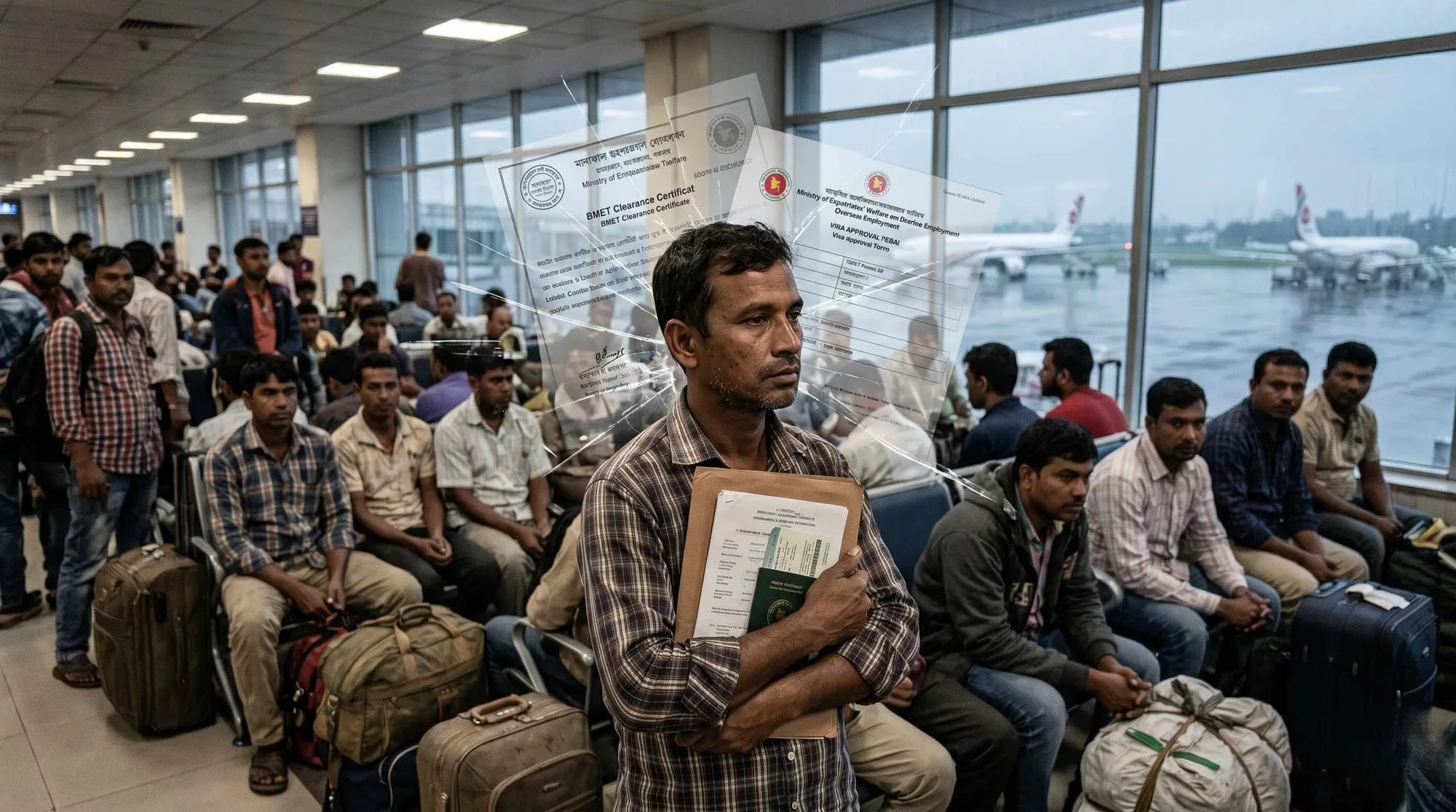

When Malaysia halted worker recruitment in mid-2024, Bangladesh’s Ministry of Expatriates’ Welfare was slow to respond — and thousands of workers with valid visas were left stranded, their savings trapped in a system that failed them at every level. The temporary suspension of Malaysia’s labor recruitment, announced via a circular dated March 1, 2024, was not a surprise. It was a scheduled administrative pause to reassess sectoral labor demand. Yet the Ministry of Expatriates’ Welfare and Overseas Employment of Bangladesh treated it as anything but urgent. The institutional inertia that followed — compounded by unauthorized agency exploitation, a chaotic refund process, and unimplemented meeting resolutions — exposed deep coordination failures at the heart of Bangladesh’s manpower export bureaucracy.
The Suspension Bangladesh Chose Not to See Coming
Malaysia’s March 1, 2024, circular was unambiguous: effective June 1, 2024, worker recruitment from all 15 source countries — Bangladesh included — would be temporarily suspended pending a reassessment of labor demand across sectors. The decision was administrative and anticipated, tied to the natural conclusion of quota fulfillment under the existing MoU framework. The correct institutional response was immediate contingency planning: mobilizing workers with valid visas, resolving flight shortages, and preparing a framework for the transition period.
Instead, the Ministry of Expatriates’ Welfare and Overseas Employment treated the circular as a low-priority matter. No significant attention was directed at ensuring the approximately 17,000 workers with valid visas and BMET clearance could actually depart before the June 1 deadline. The ministry’s acknowledgment that it did not even possess an exact list of these stranded workers speaks to a fundamental gap in real-time operational oversight — a gap that workers paid for with their time, their money, and their livelihoods.
BAIRA Steps In Where the Ministry Stood Back
The most striking data point from the final weeks of the recruitment window is not the number of stranded workers — it is the number who did make it. In May 2024 alone, 45,031 Bangladeshi workers departed for Malaysia, a figure that exceeded the combined total of 44,075 workers from all remaining 14 source countries during the same period. This outcome was not the product of ministry intervention. It was the result of active, on-the-ground mobilization by BAIRA, which organized chartered flights alongside regular services to move workers before the deadline.
The contrast is instructive. A private industry association demonstrated more operational urgency and logistical capacity than the government ministry nominally responsible for the welfare of migrant workers. The flight shortage during the Hajj season was a genuine constraint — but it was a known constraint, one that proactive planning could have partially mitigated. The ministry’s passive posture during this critical window left thousands behind.
Ministry Inaction
Despite Malaysia’s March 1 suspension circular, the ministry failed to mount an urgent response, leaving ~17,000 visa-cleared workers without a clear departure pathway before the June 1 deadline.
Unauthorized Agency Exploitation
Agencies not approved by Malaysia used dummy demand letters and powers of attorney to seize control of worker supply, relegating approved agencies to processing roles while charging workers up to 500,000 BDT.
Associate Agency Non-Compliance
Following ministry directives to refund workers, associate agencies complied at only a 25% rate — a direct consequence of unenforceable accountability frameworks and absent follow-through.
Advisor’s Reform Steps
Dr. Asif Nazrul abolished the post-demand-letter ministry approval requirement, reducing processing lead times and earning sector-wide praise — though implementation gaps continue to undermine impact.
The Unauthorized Agency Problem: Systemic Fraud by Design
The stranding of thousands of workers was not simply a logistical failure — it was also the downstream consequence of a deliberately constructed exploitation structure. Unauthorized recruiting agencies, operating entirely outside the Malaysian government’s approved list, had systematically purchased visas from employers using dummy demand letters and powers of attorney. Through this mechanism, they effectively seized control of worker selection and supply chain management, reducing the 101 approved agencies to administrative processors with no real authority over the pipeline they were nominally responsible for.
The financial consequences for workers were severe. With unauthorized agencies controlling access to visas and worker placement, migration costs were driven up dramatically — in many cases reaching 500,000 BDT or more per worker. When the suspension came and refunds were required, the accountability gap was immediately apparent: the approved agencies held the legal responsibility but not the money, while the unauthorized agencies that held the money faced no comparable enforcement mechanism. Workers were caught in the middle of a liability dispute that the ministry had allowed to develop through years of inadequate oversight.
The Refund Crisis: Resolutions Made, Enforcement Missing
Following the June 1, 2024, suspension, the ministry directed workers with valid visas and BMET clearance to register their details. Of the approximately 17,000 workers cited by the ministry, only around 4,000 came forward — a discrepancy that the ministry was unable to explain or reconcile, having no independent verification list of its own. The 101 approved agencies were then directed to refund all expenses, either directly or through their associate agencies.
At a meeting convened on August 28, 2024, by newly appointed Advisor Dr. Asif Nazrul, concrete timelines were established: approved agencies were to notify the ministry of settled liabilities by September 3, and associate agencies by September 10. Most of the 101 approved agencies met these obligations — refunding passports and payments directly or through their associates. Associate agencies, however, complied at a rate of only 25%. A September 24 follow-up meeting reiterated the urgency of the refund process, but the underlying enforcement gap remained unaddressed. Resolutions were made; implementation did not follow.
Reform Under Dr. Asif Nazrul: Progress and Its Limits
The arrival of Dr. Asif Nazrul as ministry advisor, following the formation of a new government through the anti-discrimination movement, injected visible reform energy into an institution that had been operating without strategic direction. His decision to abolish the requirement for ministry approval following demand letters authenticated by labor wings in embassies was a substantive, practical step — one that directly reduced processing lead times and removed a bureaucratic chokepoint that had slowed worker deployment without adding meaningful oversight value. The move was broadly welcomed by manpower export sector stakeholders.
Yet the limits of top-level intent without institutional follow-through have already become apparent. Meeting resolutions remain partially implemented. Advisor directives have not been converted into enforceable action by the ministry’s operational layers. The coordination failures that left 17,000 workers stranded are not resolved by good decisions at the top if the bureaucratic machinery below does not execute them. The ministry’s fundamental challenge is not vision — it is the gap between policy resolution and ground-level implementation, a gap that will continue to cost Bangladeshi workers unless structural enforcement mechanisms are built to close it.
| Event | Date | Outcome |
|---|---|---|
| Malaysia issues suspension circular | March 1, 2024 | Ministry gives minimal attention; no contingency plan initiated |
| e-Visa processing shifted to employers | January 2024 | Approved agencies lose ability to expedite visa processing |
| Final worker departure deadline | May 31, 2024 | ~17,000 visa-cleared workers unable to travel; ~4,000 later self-register |
| BAIRA-led May 2024 mobilization | May 2024 | 45,031 workers sent — more than all 14 other source countries combined |
| Suspension takes effect | June 1, 2024 | Ministry directs stranded workers to register; exact list unavailable |
| Advisor’s stakeholder meeting | August 28, 2024 | Refund deadlines set; most approved agencies comply; associate agencies at 25% |
| Follow-up meeting | September 24, 2024 | Urgency reiterated; implementation gaps persist |
What Effective Coordination Must Look Like
The Malaysia suspension episode has provided an unambiguous diagnostic of the Ministry of Expatriates’ Welfare’s coordination failures. Three structural imperatives emerge from the evidence. First, the ministry must build and maintain real-time worker tracking systems that allow it to independently verify the status of all visa-cleared and BMET-cleared workers at any given moment — the inability to confirm a list of 17,000 stranded workers is an unacceptable institutional failure for a ministry whose mandate is worker welfare. Second, enforcement mechanisms for meeting resolutions must be formalized and consequential; directives that carry no binding follow-through mechanism will continue to produce the same 25% compliance rates seen from associate agencies. Third, the unauthorized agency ecosystem that captured the Malaysia corridor must be addressed structurally, not just rhetorically — through accountability frameworks that attach liability to those who actually hold the money and control the supply chain, rather than deflecting it onto approved agencies that were systematically sidelined.
Dr. Asif Nazrul’s reform instincts are well-calibrated. But instinct without institutional infrastructure produces announcements, not outcomes. The workers who were stranded, overcharged, and underserved by the system in 2024 are owed more than good intentions from a new administration — they are owed a ministry that functions.