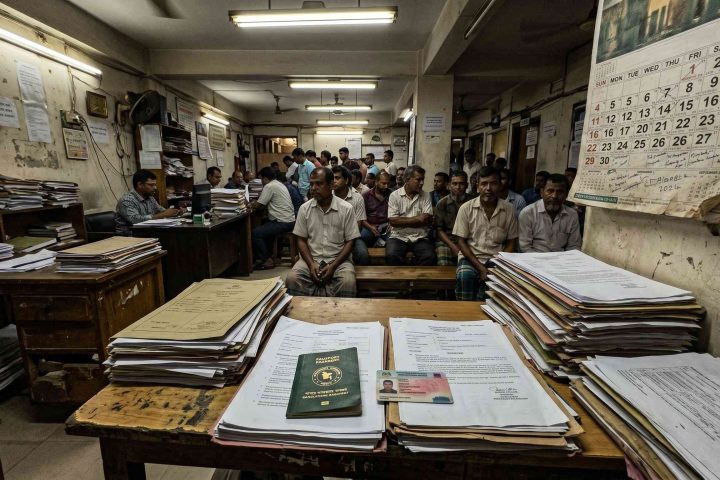
When Malaysia suspended worker recruitment on June 1, 2024, Bangladesh’s Ministry of Expatriates’ Welfare and Overseas Employment could not produce a verified list of the approximately 17,000 workers it had publicly cited as stranded — workers with valid visas and BMET clearance who had done everything right and still could not travel. That single institutional failure — the inability of a ministry mandated to protect migrant workers to account for those workers in real time — is not an anomaly. It is a symptom of three structural absences that will produce the same failures, at the same human cost, the next time a suspension hits. And there will be a next time. The Malaysia suspension of 2024 has provided the most detailed diagnostic of the Ministry of Expatriates’ Welfare’s institutional gaps in the corridor’s three-decade history. The evidence is specific, the failure points are documented, and the reforms required are identifiable. What follows is not a critique — it is a construction brief for the three systems the ministry must build before the next disruption arrives.
Why the Same Crisis Will Happen Again Without Structural Change
The 2024 suspension was not the first time the Bangladesh-Malaysia corridor entered an unplanned crisis. It was not the first time workers were stranded between two governments’ administrative timelines. It was not the first time unauthorized operators exploited the gap between the ministry’s nominal oversight and its actual visibility into the supply chain. And it will not be the last — unless the ministry builds the institutional infrastructure that would allow it to respond differently.
The corridor’s history is a recurring demonstration of the same principle: good bilateral agreements and well-intentioned advisors cannot substitute for functional institutional systems. Dr. Asif Nazrul’s decision to abolish the post-demand-letter ministry approval requirement was a meaningful reform. The August 28 stakeholder meeting produced actionable resolutions with clear timelines. But reform instinct without enforcement infrastructure produces announcements, not outcomes. The three systems described below are the minimum institutional preconditions for converting policy intent into worker protection.
System One: Real-Time Worker Tracking
The most basic institutional failure exposed by the 2024 suspension was the ministry’s inability to independently verify who was stranded. When Malaysia’s recruitment window closed on June 1, the ministry directed affected workers to register — an admission that it did not already know who they were. The approximately 17,000 figure it had been citing publicly was unverified. When registration was opened, roughly 4,000 workers came forward. The remaining 13,000 remain statistically unaccounted for in the ministry’s own records.
A ministry whose mandate is the welfare of migrant workers cannot function without knowing, at any given moment, the status of workers who have been formally cleared for departure. The data required for this system already flows through existing government infrastructure: BMET issues immigration clearances, the Bangladesh High Commission attests demand letters, and the FWCMS records visa approvals. What is missing is the integration of these data streams into a single, ministry-accessible dashboard that provides real-time visibility into the pipeline status of every cleared worker.
This is not a technically ambitious requirement. It is a data integration exercise across systems that already exist and already capture the relevant information. The obstacle is not technological — it is institutional will to build and maintain it. A functional real-time tracking system would have allowed the ministry to identify stranded workers immediately on June 1, contact them directly, coordinate with airlines on their behalf, and provide accurate figures to Malaysian counterparts in bilateral discussions. Instead, it asked workers to come forward and counted whoever showed up.
System Two: Enforceable Meeting Resolutions
The August 28, 2024, stakeholder meeting convened by Advisor Dr. Asif Nazrul produced clear, time-bound directives: approved agencies were to confirm refund completion to the ministry by September 3; associate agencies were to confirm settlements with approved agencies by September 10. These were not vague aspirational commitments — they were specific deadlines attached to specific obligations. Most of the 101 approved agencies met them. Associate agencies complied at a rate of 25%.
The 75% non-compliance rate among associate agencies is not a reflection of bad faith alone — it is the predictable outcome of a directive that carried no binding enforcement mechanism. A meeting resolution without a consequence architecture is a statement of preference, not a regulatory instrument. Associate agencies that calculated the cost of non-compliance against the cost of refunding workers made a rational institutional decision: non-compliance was cheaper.
What Enforceable Resolutions Require
Every ministry directive involving financial obligations must be accompanied by four elements: a specific deadline, a named responsible party, a verification mechanism that does not depend on self-reporting, and a defined consequence for non-compliance that is proportionate to the obligation and enforced automatically upon deadline breach — not renegotiated at a follow-up meeting.
The Follow-Up Meeting Problem
The September 24 follow-up meeting reiterated the urgency of the refund process. Reiteration is not enforcement. When non-compliance is met with a second meeting rather than a defined consequence, it signals to every actor in the system that deadlines are negotiable and obligations are aspirational. The follow-up meeting was necessary — but it should have been a compliance review, not a re-statement of the original directive.
License-Linked Accountability
The most direct enforcement mechanism available to the ministry is license-linked accountability: associate agencies that fail to meet financial obligations to workers within specified deadlines face automatic suspension of their operating licenses pending compliance verification. This mechanism already exists in principle within the ministry’s regulatory authority. Its consistent application would transform the compliance calculus for every actor in the supply chain.
Transparent Public Compliance Tracking
Compliance rates — which agencies have met their obligations and which have not — should be published on the ministry’s public platform in real time. Transparency does not replace enforcement, but it eliminates the information asymmetry that allows non-compliant actors to delay without reputational consequence. Malaysian employers and the Malaysian government also have an interest in knowing which agencies in the Bangladesh pipeline are meeting their worker welfare obligations.
System Three: Unauthorized Agency Liability Framework
The deepest structural failure exposed by the 2024 crisis is the mismatch between where liability sits in the Bangladesh-Malaysia recruitment supply chain and where money and operational control actually reside. Unauthorized agencies — operating entirely outside the Malaysian government’s approved list — used dummy demand letters and fake powers of attorney to capture control of worker selection, visa procurement, and supply chain management. They charged workers up to 500,000 BDT. They paid Malaysian employers through illegal overcharging of workers. And when the suspension came and refunds were required, the liability fell on the 101 approved agencies — who had been reduced to processing roles and held neither the money nor the operational authority the refund obligation implied.
This is not a gray area. It is a documented accountability inversion: the parties who extracted value from workers bear no formal liability for returning it, while the parties who held formal licenses but had been systematically sidelined from operational control are held responsible for funds they never received. No refund framework built on this liability structure will produce adequate worker protection — because it attaches the obligation to the wrong actor.
What the Unauthorized Agency Liability Framework Must Include
| Component | Current Gap | Required Mechanism |
|---|---|---|
| Supply chain documentation | No mandatory disclosure of sub-contracting arrangements or payment flows between approved and associate agencies | All financial flows from worker to employer must be documented and disclosed to BMET at clearance stage; undisclosed payments create automatic liability |
| Unauthorized operator identification | No systematic mechanism to identify agencies operating outside the approved list but within the supply chain | Mandatory declaration by approved agencies of all associate relationships; BMET cross-reference against approved list at each processing stage |
| Financial liability assignment | Refund obligations default to approved agencies regardless of who received the money | Financial liability follows money — the entity that collected fees from workers holds primary refund obligation, with secondary liability on approved agency only where it received documented payment |
| Criminal referral threshold | Dummy demand letters and fake powers of attorney treated as administrative irregularities rather than fraud | Use of forged documents to control worker supply constitutes fraud; referral to Anti-Corruption Commission or law enforcement must be automatic, not discretionary |
| Employer-side accountability | Malaysian employers who sold visas to unauthorized agencies face no Bangladesh-side consequence | Ministry to formally notify Malaysian authorities of employer-side visa trading; bilateral enforcement mechanism required for repeat violations |
The Institutional Architecture That Makes All Three Systems Work
Each of the three systems described above is independently valuable. Together, they create an institutional architecture in which the ministry can see what is happening in real time, make directives that are actually followed, and attach liability to the actors who hold operational control and financial benefit. This architecture does not require new legislation in most of its components — it requires the consistent application of authority the ministry already holds, supported by data systems that integrate information already being collected.
The critical implementation condition is that these systems must be built and tested during the current period — before Malaysia reopens, before the next surge begins, and before the next disruption creates the same pressure to improvise responses to failures that could have been prevented. Building institutional infrastructure under crisis conditions produces exactly the kind of rushed, inadequate solutions that created the current gaps. The window between the 2024 suspension and the anticipated reopening is not dead time — it is the only opportunity to build these systems without the distorting pressure of an active crisis.
The workers who were stranded in 2024 — who had their passports held, their savings trapped, and their departure blocked by a combination of flight shortages, unauthorized agency exploitation, and ministerial inaction — did not fail the system. The system failed them. Building these three institutional components is the minimum the ministry owes the next cohort of workers who will clear their BMET documentation, obtain their visas, and trust that the system watching over them is actually watching.