SUMMARY
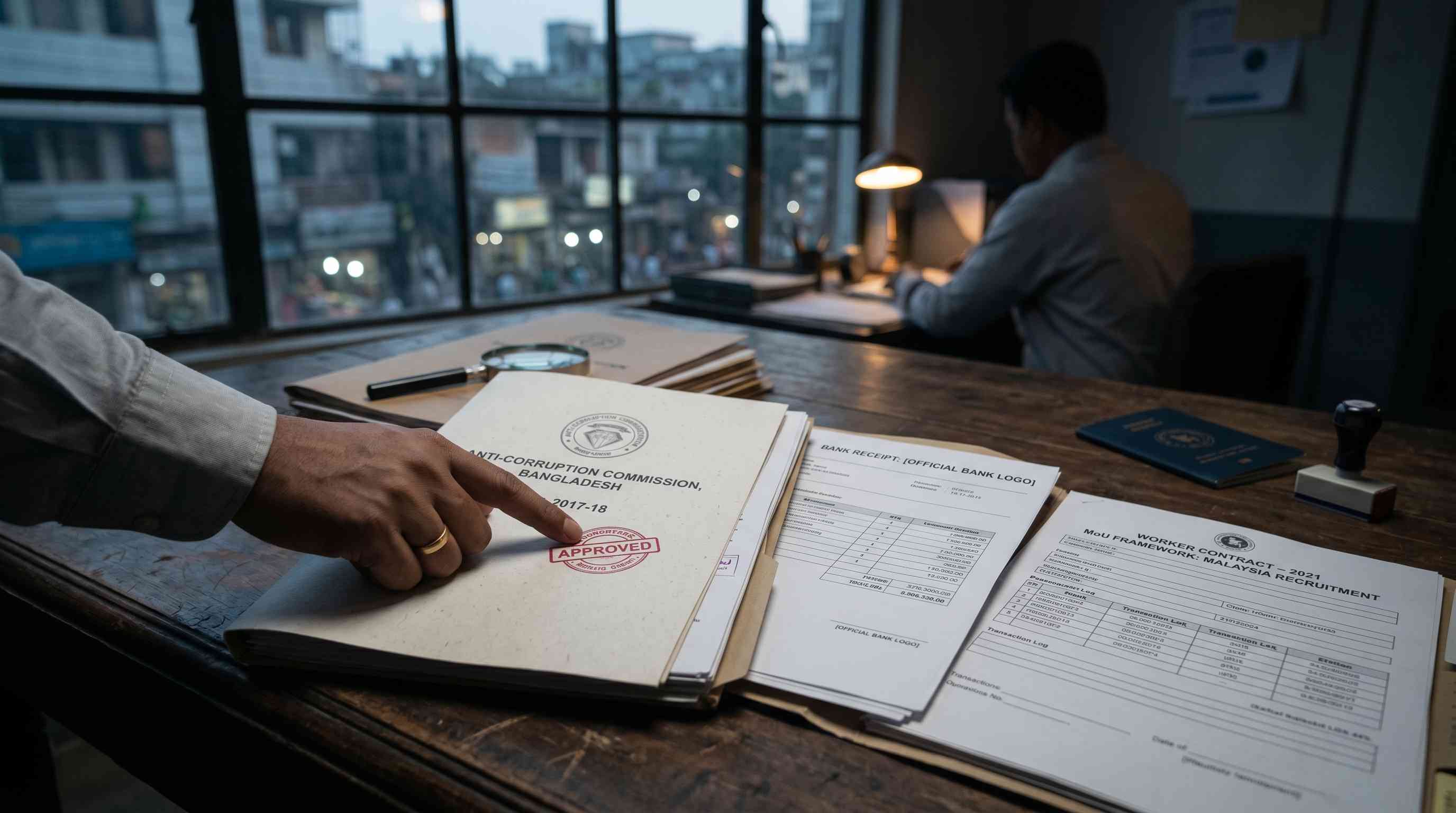
Under the 2021 Bangladesh–Malaysia MoU framework, all payments collected by the 101 listed recruiting agencies were governed by a strict three-layer compliance mechanism: fees were capped at the government-approved ceiling, formal receipts were mandatory for every worker, and all transactions had to be conducted through official banking channels. This institutional architecture left no systemic room for unrecorded, informal, or inflated charges within the authorized pipeline. Consequently, a review of the formal payment framework presents a sharp contrast to the prevailing media narrative of rampant overcharging by listed agencies.
KEY TAKEAWAYS
- Three-Layer Compliance Architecture: Recruitment payments were bound by government-approved fee ceilings, mandatory individual receipts, and official banking channels.
- Automated Upstream Protection: FWCMS Auto Allocation assigned quotas directly to 101 agencies from the Malaysian government, eliminating commercial visa trading and upstream cost inflation.
- Documented Low & Zero-Cost Pathways: The framework enabled 358 workers to deploy free of charge under the Employers Pay Model via Catharsis International, alongside nearly 2,000 low/no-cost deployments via state-run BOESL.
The term “government-approved migration fees” has a specific and binding meaning within the Bangladesh–Malaysia recruitment framework. Fees were defined within the bilateral framework established by the December 19, 2021 MoU and its operational guidelines—setting a uniform ceiling that listed agencies were required to observe for every worker processed through the migration pipeline. Charging above that ceiling was a prohibited act within a framework jointly supervised by the Malaysian government and Bangladesh’s Ministry of Expatriates’ Welfare and Overseas Employment. Under Malaysia’s FWCMS Auto Allocation System, worker quotas were distributed directly to the 101 enlisted agencies, eliminating the necessity to purchase visa access from employers outside controlled channels.
“The payment framework—government-approved fees, mandatory receipts, and official banking channels—was designed precisely to prevent informal and inflated payment practices.”
— Bilateral Operational Guidelines, 2021 Bangladesh–Malaysia MoU Framework
1. Four Components of the Payment Compliance Framework
STEP 01
Government-Approved Fee Ceiling
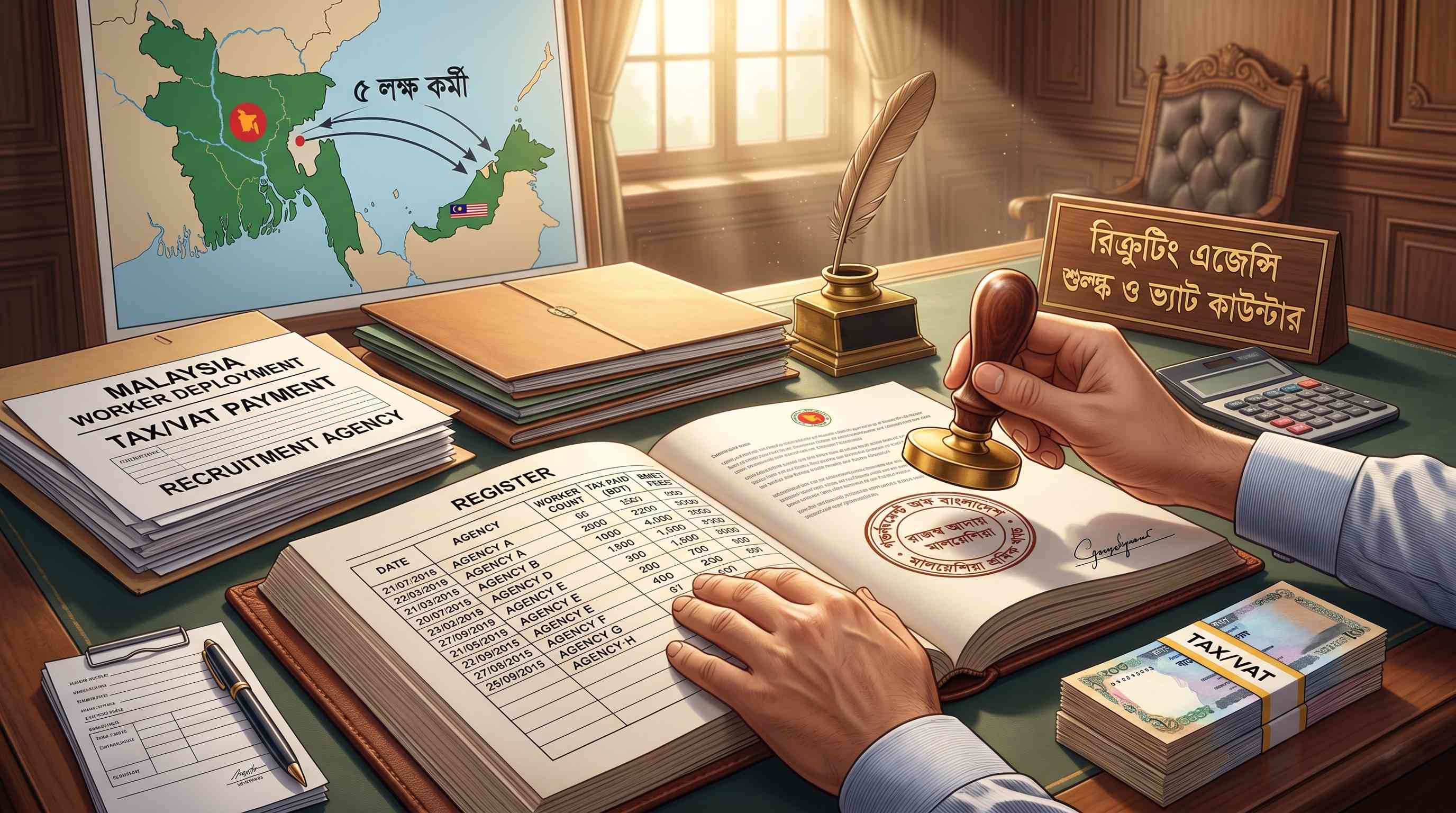
Migration fees were legally defined by the bilateral framework rather than set unilaterally by agencies. The ceiling applied to all 101 enlisted agencies equally, establishing a verifiable maximum cost baseline.
STEP 02
Mandatory Worker Receipts
Every migrant worker received a formal receipt at the point of transaction, creating enforceable legal documentation and a verifiable compliance trail across the entire 476,672-worker deployment.
STEP 03
Official Banking Channels
All recruitment charges were routed through formal banking institutions. This independent financial trail aligns with the ACC’s 2017–18 investigation findings, which identified no illegal fund transfers by listed agencies.
STEP 04
FWCMS Auto Allocation
Quotas were allocated straight to agencies via FWCMS by the Malaysian government, eliminating visa trading and ensuring the cost ceiling was not compromised by middlemen margins.
Beyond departure processing, arriving workers were protected by bilingual, legally binding contracts specifying a minimum basic salary of 1,500 Ringgit per month—with earnings reaching approximately BDT 50,000 per month including overtime. Supervision was maintained jointly by the Malaysian government and the Bangladesh High Commission in Kuala Lumpur, ensuring authorized agencies remained accountable for post-arrival contractual adherence.
2. Historical Timeline of Corridor Governance
2017–2018
The Anti-Corruption Commission (ACC) of Bangladesh conducts an exhaustive inquiry into remittance mechanisms and finds no evidence of illegal cross-border fund transfers by listed recruiting agencies.
December 19, 2021
Bangladesh and Malaysia formally execute a bilateral Memorandum of Understanding (MoU), establishing strict fee caps, FWCMS integration, mandatory worker receipting, and banking protocols.
August 2022 – May 2024
A total of 476,672 Bangladeshi workers are deployed to Malaysia under regulated channels. The operational cycle accommodates 358 zero-cost placements via Catharsis International and nearly 2,000 low/no-cost placements via BOESL.
Present Day
Institutional reviews confirm that documented payment records, banking transaction trails, and multi-agency oversight directly refute external allegations of undocumented and inflated fee structures.
3. Verified Record vs. Circulating Claims
| Claim in Circulation | Verified Fact & Operational Reality |
|---|---|
| Agencies charged inflated migration fees | Only government-approved fees collected; formal receipts issued to all workers |
| Agencies sent money to Malaysia illegally | ACC investigation (2017–18) found no evidence; all payments under current MoU received via official banking channels |
| Listed agencies bought and sold visas | Quotas auto-allocated via FWCMS; agencies had no mechanism or incentive to purchase visas from employers |
| No low-cost migration options exist | 358 workers sent under Zero Cost Employers Pay Model; BOESL sent nearly 2,000 workers at low or no cost |
| Workers received no wage protection | Minimum basic salary of 1,500 Ringgit; total earnings approximately BDT 50,000 per month including overtime |
Sources & References
Bangladesh–Malaysia Memorandum of Understanding (MoU) on Worker Employment (Dec 19, 2021) PDF ↓
Foreign Workers Centralised Management System (FWCMS) Auto Allocation Portal Link ↗
Anti-Corruption Commission (ACC) Institutional Inquiry Report on Overseas Manpower Remittance (2017–18) Link ↗