Bangladesh’s Malaysia Labour Corridor: Allegations Examined, Evidence Presented, and a $3 Billion Future at Stake

As internal competition and upcoming BAIRA elections fuel a wave of mutual accusations among Bangladesh’s recruiting agencies, a closer examination of verified facts, official documents, and cross-border investigations reveals a more complex picture — one where unauthorized intermediaries, not listed agencies, sit at the center of inflated migration costs, visa trading, and supply chain manipulation in Bangladesh’s labor corridor to Malaysia.
Why the Market Closed: The Full History of Irregularities (1992–2009)
From 1992 — when the first formal bilateral labor agreement was signed — until 2009, Bangladesh’s manpower export to Malaysia operated exclusively through private recruiting agencies. That period was defined by a mounting catalogue of abuses: passport forgery, falsified or tampered personal information, the illegal entry of individuals with criminal records, systematic flaws in the manual immigration process, workers absconding from contracted employers, exploitation by fraudulent agents, and the use of tourist visas to gain unauthorized employment. These practices eroded both Malaysian government and employer confidence in Bangladeshi labor recruitment comprehensively. At its worst, the system produced mass unemployment among newly arrived workers — some employers had recruited far more workers than their operations required, in collaboration with Bangladeshi agencies. Thousands of workers, unpaid and unhoused, gravitated toward Kuala Lumpur, gathering at the Bangladesh High Commission and sleeping under bridges and in open fields. The resulting public dissatisfaction in Malaysia was severe. On March 10, 2009, Malaysia formally closed its labor market to Bangladeshi workers — a ban that would last until 2012.
Setting the Record Straight: Fact vs. Allegation
On Syndicate Formation: Not Substantiated
The 101 approved agencies were selected by the Malaysian government through an online, transparent process from a full list of 1,520 valid licenses submitted by the Ministry of Expatriates’ Welfare. This procedure was established under the December 2021 MoU and confirmed in the Agreed Minutes of the June 2022 Joint Working Group meeting. The selection was Malaysia’s sovereign decision, not a cartel arrangement by Bangladeshi agencies.
On Visa Trading by Listed Agencies: Not Accurate
The FWCMS Auto Allocation System automatically distributed worker quotas among the 100 private approved agencies. Because quotas were allocated — not purchased — there was no mechanism or incentive for listed agencies to trade visas. All listed agencies charged government-prescribed migration costs and provided receipts to workers. No worker has alleged payment in excess of the official government rate against a listed agency.
On Money Laundering: Investigated, Unproven
Malaysia’s Anti-Corruption Commission (MACC) Chief Commissioner Tan Sri Azam Baki confirmed publicly that MACC investigated allegations of money laundering related to Bangladeshi worker recruitment and found no supporting evidence. The case against Bestinet was closed due to a lack of criminal evidence. A 2017-18 Anti-Corruption Commission investigation in Bangladesh similarly concluded the allegations were unfounded.
On Cost Inflation: Unauthorized Agencies Are the Source
Approximately 1,100 unlisted intermediaries and unauthorized agencies — operating through dummy demand letters and notarized powers of attorney — inserted themselves into the worker supply chain, gaining control over worker selection. Having sidelined listed agencies to processing roles, these actors charged workers up to 500,000 BDT or more. Malaysia’s own Human Resources Minister addressed this dynamic directly in a public media statement.
The Controlled Framework: G2G, G2G Plus, and FWCMS
Malaysia’s decision to limit the number of authorized recruiting agencies was a deliberate policy response to history, not an arbitrary restriction. After the failure of the 2012 G2G-only system — which attracted only ~8,000 migrants against a 30,000 quota due to minimal employer interest — the February 2016 G2G Plus MoU introduced up to ten private agencies as an addition to the government channel. Malaysia’s stated rationale was explicit: fewer agencies meant clearer accountability, more traceable irregularities, and better-monitored compliance. The Foreign Workers Centralized Management System (FWCMS), a fully automated digital platform integrated with ministries across both governments, was deployed to support this framework — digitizing demand letter verification, worker selection, health screening, pre-departure orientation, and BMET exit clearance. Between 2017 and 2018, approximately 278,000 workers migrated through this structure without major worker complaints, validating the model’s operational effectiveness.
Timeline: Three Decades of Openings, Closures, and Reform
1978
Informal migration of Bangladeshi workers to Malaysia begins, without a formal bilateral framework.
1992
First official bilateral labor agreement signed. Private recruiting agencies gain exclusive operational control of the market.
1992–2008
Repeated cycles of market closure and reopening due to passport fraud, criminal infiltrations, illegal employment, and employer exploitation under agency management.
March 10, 2009
Malaysia formally closes its labor market to Bangladeshi workers following severe and sustained irregularities. Thousands of unpaid workers had gathered in Kuala Lumpur.
2012
A G2G MoU reopens the market. Malaysia issues a 30,000-worker demand letter; Bangladesh registers 1.4 million workers via BMET. Only ~8,000 migrate due to low employer interest.
2015
Mass graves of Bangladeshi migrants discovered at the Thai-Malaysia border, exposing the deadly consequences of illegal migration. Malaysia grows more cautious about reopening the market fully.
February 18, 2016
G2G Plus MoU signed. Up to ten private agencies authorized alongside the G2G channel. FWCMS digital platform introduced to automate and secure the recruitment pipeline.
2017–2018
Approximately 278,000 workers migrate through the G2G Plus system without major complaints. Misinformation from some agencies and regional competition prompt Malaysia to suspend the program in March 2019.
December 2019
Malaysia’s Human Resources Minister M. Kulasegaran tables an investigative report in Parliament finding no substantial evidence supporting the suspension-triggering allegations.
December 19, 2021
A new MoU is signed through active initiatives from both governments and BAIRA. Recruitment authorized through 25 agencies, later expanded to 101 including BOESL.
June 2, 2022
Joint Working Group meeting confirms Malaysia will select agencies from the ministry-provided list through an online transparent process. Recruitment commences.
August 2022 – May 2024
476,672 Bangladeshi workers deployed to Malaysia under the 101-agency framework. Remittance inflows grow 71% year-on-year. Malaysia rises from 8th to 4th in Bangladesh’s remittance rankings.
June 1, 2024
Malaysia temporarily halts recruitment from all 15 source countries after issued quotas exceed the Economic Planning Unit’s approved 2.5 million foreign worker target.
The Remittance Record and Future Potential
The economic case for maintaining and expanding this labor corridor is grounded in measurable data. Remittance from Malaysia stood at 1,021.85 million USD in FY 2021-22, rose to 1,125.90 million USD in FY 2022-23, and surged to 1,744.40 million USD in FY 2023-24 — a 71% increase over two fiscal years. In the first six months of FY 2024-25 alone, remittance from Malaysia reached 1,515.60 million USD, placing the full-year projection on a trajectory toward 3 billion USD — three times the FY 2021-22 baseline. Workers currently earn a minimum of 1,700 Ringgit per month; at this rate, 476,672 workers would collectively generate at least 26,255 crore BDT annually. If the Malaysian government reopens recruitment at reasonable migration costs, projections indicate at least 200,000 workers could be deployed to plantation and agriculture sectors in 2025, with a potential cumulative deployment of nearly 1 million workers over five years.
The Path to Reopening: Key Recommendations
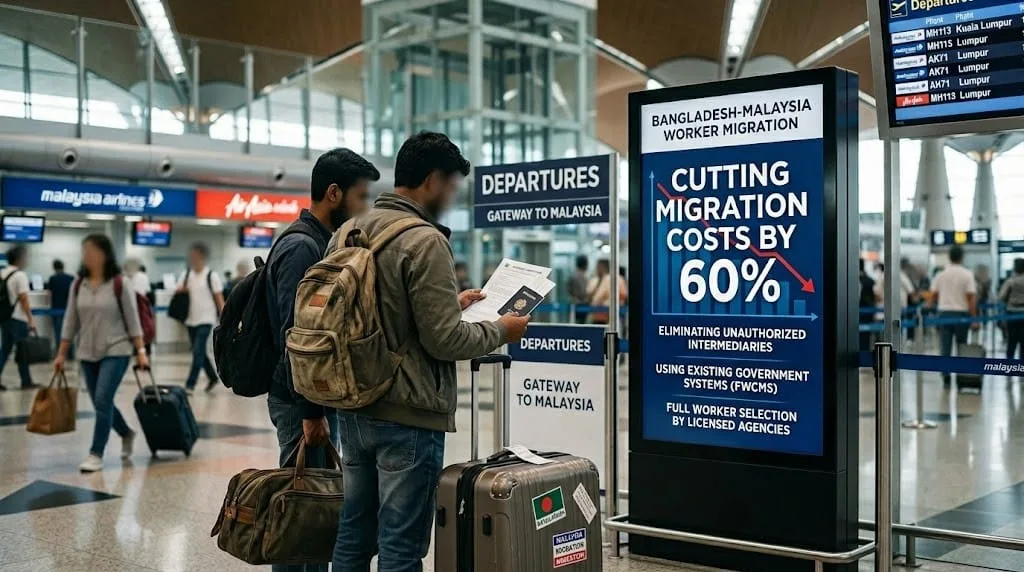
The evidence points to a clear structural remedy. Eliminating the appointment of intermediaries through employer-issued powers of attorney — and restoring full worker selection and process authority to the 101 government-approved agencies — is projected to reduce migration costs by at least 60%. The FWCMS auto-allocation system already exists to make this possible without creating new bureaucratic infrastructure. What is required is enforcement of the existing framework’s boundaries. Additionally, repeated domestic investigations or media campaigns directed at listed agencies — without evidentiary basis — have the demonstrated effect of discouraging Malaysian employers and redirecting their hiring interest toward competing source countries, directly harming Bangladeshi workers and the national remittance economy. Productive government-to-government engagement, combined with sector stability and reliable agency compliance, represents the clearest path to reopening and expanding one of Bangladesh’s most significant labor markets.
Source:Bangladesh–Malaysia MoU | Joint Working Group Agreed Minutes | MoU Points C.5 & C.6 | MACC Chief Statement – Scoop Malaysia | Bernama: No Extension of May 31 Deadline