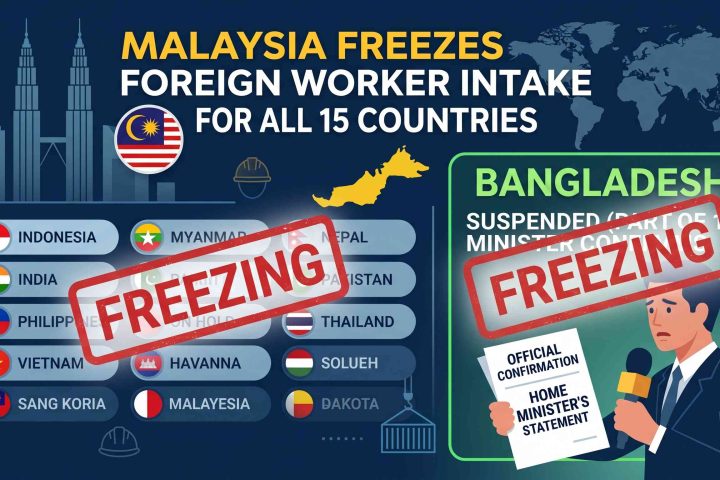
As Malaysia temporarily pauses labor recruitment from all source countries, data from Bangladesh’s own remittance records tells a compelling story: the Bangladesh–Malaysia labor corridor has quietly grown into one of the nation’s most powerful economic lifelines — and a structured reopening could push annual inflows toward 3 billion USD, transforming the lives of hundreds of thousands of Bangladeshi workers and their families.
A Corridor Quietly Rewriting Bangladesh’s Remittance Map
Three years ago, Malaysia ranked eighth among Bangladesh’s remittance source countries. Today it sits fourth — and the trajectory points sharply upward. The numbers behind this shift are not the result of a single policy breakthrough but of a structured bilateral framework that placed 476,672 Bangladeshi workers in Malaysian workplaces between August 2022 and May 2024. Each worker, earning a minimum of 1,700 Ringgit per month, contributes to what has become one of Bangladesh’s fastest-growing foreign income streams. The aggregate annual earning of the current worker base is estimated at 26,255 crore BDT — a figure that will rise significantly if the corridor expands as projected.
The Remittance Numbers, Year by Year
| Fiscal Year | Remittance from Malaysia | Change |
|---|---|---|
| FY 2021-22 | 1,021.85 million USD | Baseline |
| FY 2022-23 | 1,125.90 million USD | +10.2% |
| FY 2023-24 | 1,744.40 million USD | +54.9% |
| FY 2024-25 (First 6 months) | 1,515.60 million USD | On track for ~3 billion USD |
What Is Driving the Growth
A Structured Bilateral Framework
The December 2021 MoU between Bangladesh and Malaysia established a formal recruitment structure through 101 government-approved agencies. This framework, supported by Malaysia’s automated Foreign Workers Centralized Management System (FWCMS), digitized the entire recruitment pipeline — from demand letter verification to pre-departure orientation — providing accountability at every step and enabling the large-scale, organized deployment of nearly half a million workers.
Proven Wage Floors and Consistent Earnings
Malaysian labor law sets a minimum wage of 1,700 Ringgit per month for foreign workers. Applied across 476,672 deployed workers, this floor generates an estimated 26,255 crore BDT in annual collective earnings. Because formal recruitment channels ensure workers are placed with registered employers, wage compliance rates are significantly higher than under informal migration — directly translating into stronger and more consistent remittance flows back to Bangladesh.
Sector Demand: Plantation and Agriculture
Malaysia’s plantation and agriculture sectors face persistent labor shortages that Bangladeshi workers are well-positioned to fill. Projections indicate that at least 200,000 workers could be deployed to these sectors in 2025 alone if recruitment resumes at accessible migration costs. Over a five-year horizon, a cumulative deployment of nearly 1 million workers is considered achievable — a scale that would fundamentally reshape Bangladesh’s remittance geography.
Migration Cost as the Critical Variable
The single factor most likely to determine whether this potential is realized is the cost of migration. Evidence indicates that restoring full worker selection authority to the 101 government-approved agencies — and eliminating unauthorized intermediaries from the supply chain — could reduce migration costs by at least 60%. Lower costs mean more workers can afford to go, more families benefit, and net remittance per worker increases. The FWCMS auto-allocation system already exists to make this possible without new infrastructure.
The Road That Led Here: A Three-Decade Timeline
1992
First official bilateral labor agreement signed between Bangladesh and Malaysia. Private recruiting agencies gain exclusive operational control of the market.
March 10, 2009
Malaysia formally closes its labor market to Bangladeshi workers following sustained irregularities accumulated over nearly two decades of private agency management.
2012
A Government-to-Government MoU reopens the market. A 30,000-worker quota is issued; only ~8,000 migrate due to minimal employer interest in the G2G-only model.
February 18, 2016
The G2G Plus MoU authorizes up to ten private agencies alongside the government channel. Malaysia’s FWCMS digital platform is deployed to automate and secure the recruitment pipeline.
2017–2018
Approximately 278,000 workers migrate through the G2G Plus system without major complaints, validating the structured, limited-agency model.
December 19, 2021
A new MoU is signed. Recruitment is authorized through 101 agencies including BOESL. The FWCMS auto-allocation system distributes worker quotas among approved agencies.
August 2022 – May 2024
476,672 Bangladeshi workers are deployed to Malaysia. Remittance inflows grow 71% over two fiscal years. Malaysia rises from 8th to 4th in Bangladesh’s remittance source rankings.
June 1, 2024
Malaysia temporarily halts recruitment from all 15 source countries after issued quotas exceed the Economic Planning Unit’s approved 2.5 million foreign worker ceiling.
The Economic Case for Reopening
The first six months of FY 2024-25 produced 1,515.60 million USD in remittance from Malaysia — before the corridor has even fully resumed. Annualized, that figure approaches 3 billion USD, nearly three times the FY 2021-22 baseline of 1,021.85 million USD. For context, this would place Malaysia among the very top contributors to Bangladesh’s total remittance income, which funds foreign exchange reserves, supports the taka, and sustains millions of households. The plantation and agriculture sectors that are awaiting Bangladeshi workers represent stable, long-term employment — not project-based or seasonal labor. Workers who secure formal placements through the approved framework earn documented wages, are covered by Malaysian labor protections, and send remittance through formal banking channels. Every element of the economic equation points in the same direction: a structured, cost-accessible reopening of the Bangladesh–Malaysia labor corridor would be among the highest-return labor policy decisions available to both governments today.