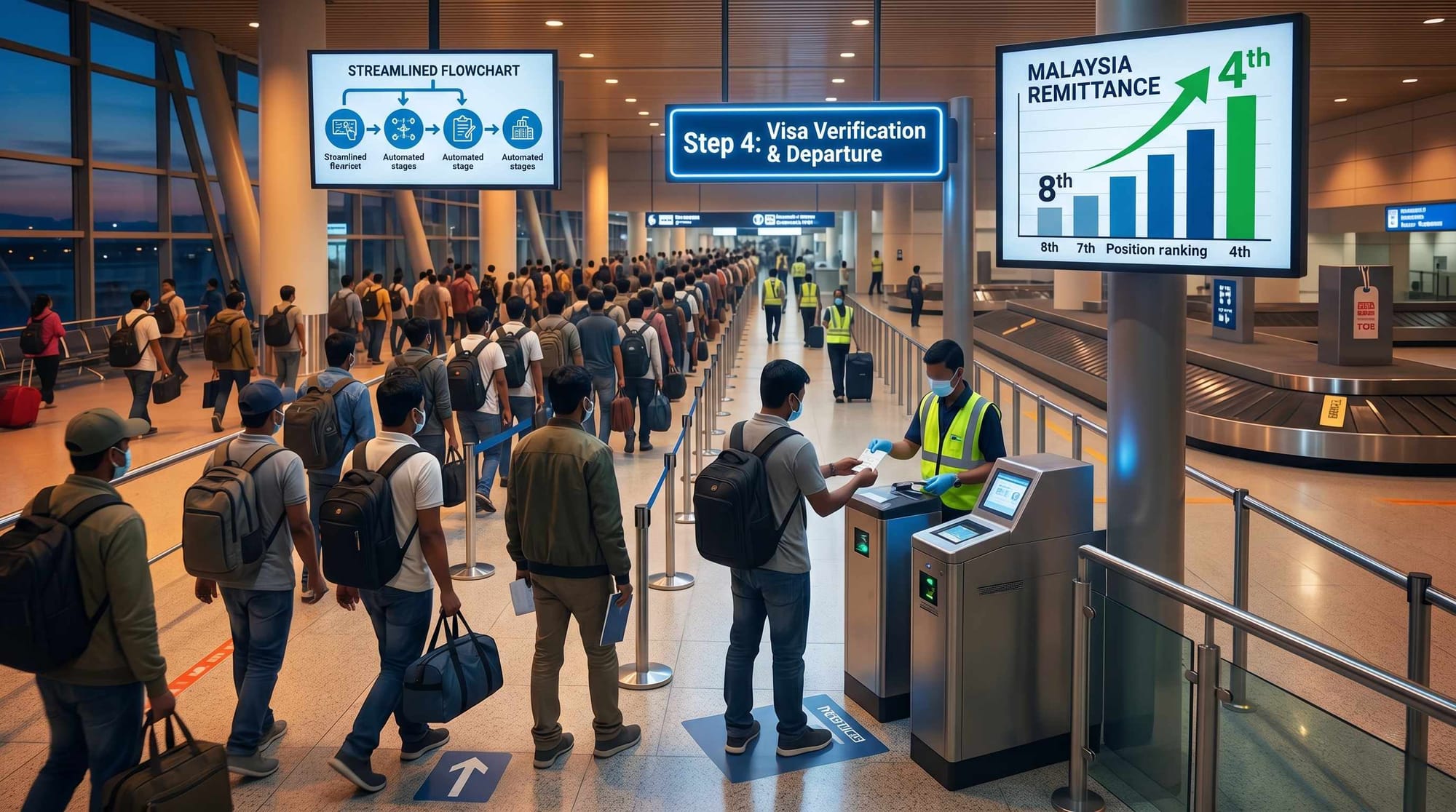
In under two years, a single Memorandum of Understanding and a framework of 101 Malaysian government-approved Bangladeshi agencies facilitated the migration of 472,476 workers to Malaysia — a deployment pace unmatched in the history of the bilateral labor corridor, and one that has already moved Malaysia from 8th to 4th place in Bangladesh’s remittance source country rankings.
The Two Documents That Built the Pipeline
The deployment of nearly half a million Bangladeshi workers to Malaysia traces back to two foundational documents. The first is the Memorandum of Understanding signed on December 19, 2021. The second is the Agreed Minutes of the Joint Working Group meeting held on June 2, 2022. At that JWG meeting, Malaysia took a firm stance — it would recruit workers through a limited number of agencies and retain the right to select those agencies itself. Bangladesh, weighing the value of overseas employment opportunities for its workers, agreed to this condition. From that point, the Malaysian government selected 101 agencies from a list provided by Bangladesh’s Ministry of Expatriates’ Welfare and Overseas Employment, including BOESL from the public sector. The result was the most concentrated and productive deployment period in the history of the Bangladesh–Malaysia labor corridor.
The Five-Step Process: From Quota to Clearance
The operational framework governing worker migration to Malaysia under the MoU mirrors the processes Bangladesh uses for Gulf states, Middle Eastern countries, and Singapore — markets where, similarly, not all Bangladeshi agencies are authorized to operate. The pipeline moves through five sequential, verified stages that together form a complete and transparent recruitment chain.
| Step | Stage | Responsible Authority |
|---|---|---|
| 1 | Worker Quota Allocation | Auto-Allocation System (Among 101 Approved Agencies) |
| 2 | Demand Letter Verification | Bangladesh High Commission in Malaysia |
| 3 | Recruitment Permit Issuance | Ministry of Expatriates’ Welfare and Overseas Employment |
| 4 | Visa Issuance | Malaysian Immigration Authorities |
| 5 | Exit Clearance | Bureau of Manpower, Employment and Training (BMET) |
What Makes This Framework Work
Auto-Allocation Removes Quota Trading
Within the 101 approved agencies, worker recruitment quotas are assigned through an auto-allocation system. This design removes the possibility of quota purchase or visa trading at the allocation stage. Each agency receives its share through a consistent, system-driven process — the same mechanism Bangladesh applies to its manpower export framework for Saudi Arabia, other Gulf states, and Singapore.
A Standard Model, Not a Special Exception
Bangladesh’s migration process for Malaysia operates under the same structural logic as its other major destination markets. In each case, only agencies approved by the destination country’s relevant authorities are permitted to facilitate migration. Malaysia’s limited-agency model is a consistent feature of destination-country labor policy — one Bangladesh has accepted and operationalized across multiple bilateral agreements.
High Commission Verification at the Source
A critical layer of the framework is demand letter verification by the Bangladesh High Commission in Malaysia. Before the Ministry of Expatriates’ Welfare issues recruitment permits for specific workers, each demand letter must pass through this verification step — ensuring that job offers are legitimate, employer-registered, and aligned with the terms agreed under the MoU before any worker is formally assigned.
BMET as the Final Safeguard
The final stage before a worker boards a flight to Malaysia is BMET exit clearance. This step ensures that every migrating worker has completed all required pre-departure processes — including health screening and pre-departure orientation — and that their documentation is in order. BMET’s clearance function serves as the last institutional checkpoint in a sequence designed to protect workers and maintain the integrity of the corridor.
Timeline: From MoU to Record Deployment
December 19, 2021
Bangladesh and Malaysia sign a new Memorandum of Understanding, establishing the legal foundation for a structured, large-scale worker deployment framework through a limited number of approved agencies.
June 2, 2022
The Joint Working Group meeting is held. Malaysia confirms it will select agencies from a list provided by Bangladesh’s Ministry of Expatriates’ Welfare. The auto-allocation system and five-step recruitment process are confirmed as the operational framework.
August 8, 2022
Formal recruitment commences under the 101-agency framework. Workers begin departing Bangladesh for Malaysia through the verified, ministry-supervised pipeline established at the JWG meeting.
FY 2023-24
Malaysia advances from 8th to 5th place in Bangladesh’s remittance source country rankings as deployment volumes and formal wage transfers grow significantly through the corridor.
July–August 2024
Malaysia rises further to 4th place in Bangladesh’s remittance rankings within just the first two months of FY 2024-25, reflecting the cumulative economic impact of the 472,476 workers deployed since August 2022.
May 31, 2024
The deployment tracking period closes. A total of 472,476 Bangladeshi workers have been successfully placed in Malaysia — the largest and fastest deployment in the history of this bilateral labor corridor.
The Remittance Outcome: Rankings Rewritten
The macroeconomic impact of the deployment is measurable and direct. Malaysia advanced from 8th to 5th position in Bangladesh’s remittance source country rankings during FY 2023-24. Within the first two months of FY 2024-25 — July and August — it climbed further to 4th place. This trajectory is a direct reflection of the scale of worker deployment and the consistency of formal banking channel wage transfers. Every worker placed through the verified five-step pipeline represents a source of steady, documented remittance income flowing back to Bangladesh. The combined effect of 472,476 such placements has repositioned Malaysia as one of the most significant contributors to Bangladesh’s foreign exchange earnings — an outcome that was made possible, step by step, by the bilateral framework established in December 2021 and operationalized in June 2022.