500,000 BDT Per Worker: The Unauthorized Agencies That Looted Bangladesh’s Malaysia Migration System

Hundreds of Bangladeshi workers paid over 500,000 BDT each to unauthorized recruiting agencies that operated entirely outside the Malaysia-approved migration framework — collecting fees, acquiring visas through fraudulent means, and vanishing before the June 1 deadline, leaving workers stranded and the official system in disarray.
While Bangladesh maintained a list of 101 government-approved recruiting agencies authorized to send workers to Malaysia, a parallel network of shadow operators effectively hijacked the supply chain. These entities obtained visas using dummy demand letters and forged powers of attorney — documents that gave them the appearance of legitimacy while bypassing every formal safeguard built into the bilateral labor migration system.
How the Shadow Pipeline Operated
Dummy Demand Letters
Unauthorized agents fabricated or sourced fraudulent demand letters from Malaysian employers, creating a false paper trail that mimicked legitimate recruitment.
Forged Powers of Attorney
Forged legal documents allowed shadow agencies to act as authorized representatives, enabling them to process visas without any sanctioned mandate.
Fee Extraction
Workers were made to pay 500,000 BDT or more per person — money collected upfront with no guarantee of deployment or legal protection.
Collapse at Deadline
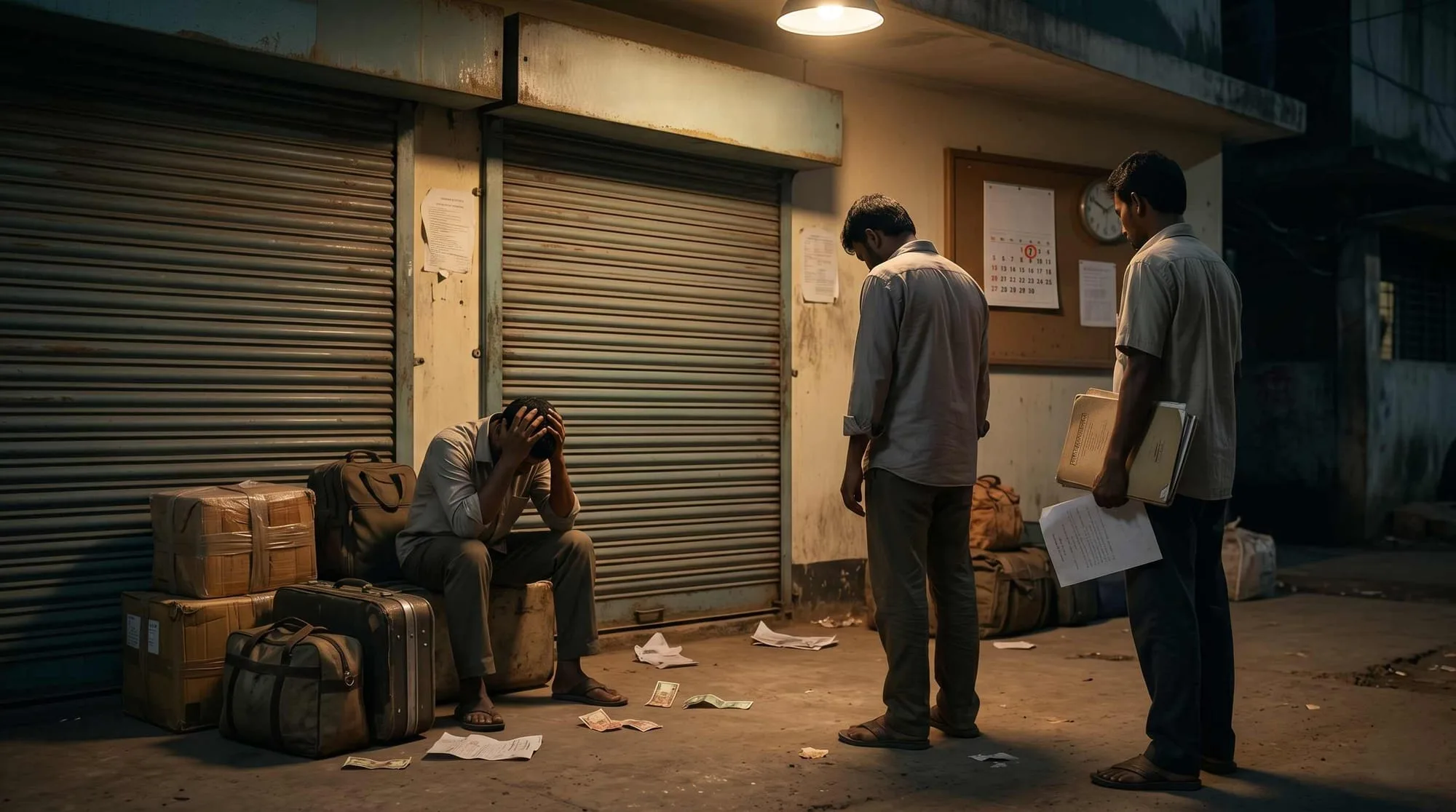
When the June 1 deadline triggered a formal closure of the recruitment window, the unauthorized operators had already exited, leaving workers with neither jobs nor refunds.
The Rubber-Stamping of Official Agencies
The 101 government-approved agencies, meant to serve as the backbone of the Bangladesh-Malaysia labor corridor, were systematically bypassed. With shadow actors controlling the actual visa supply through forged documentation, the approved agencies had little functional role. They became rubber stamps — nominally part of the process but stripped of meaningful participation in the actual movement of workers or money.
This structural hollowing-out meant that when the migration window closed, there was no legitimate agency chain intact to handle worker grievances, process refunds, or provide documentation. The accountability gap was total: those who collected the money were never part of any registered or traceable system.
Timeline of the Crisis
Pre-Deadline Period
Unauthorized agencies actively recruited workers, collected fees exceeding 500,000 BDT, and processed visa applications using dummy demand letters and forged powers of attorney.
Official Framework Active
The 101 approved agencies remained on paper while shadow operators controlled the actual pipeline — acquiring visas and managing worker placement outside sanctioned channels.
June 1 Deadline
The formal closure of the Malaysia recruitment window exposed the fraud. Shadow agencies had already exited, leaving workers stranded without documentation, jobs, or reimbursement.
Post-Deadline
With no traceable operator remaining in the chain, affected workers faced a complete absence of accountability — no agency, no refund mechanism, no legal representative to pursue.
Structural Breakdown at a Glance
| Factor | Official Framework | Shadow Operation |
|---|---|---|
| Agency Authorization | 101 govt-approved agencies | Unregistered, unaccountable actors |
| Visa Acquisition Method | Formal demand from verified employer | Dummy demand letters, forged PoA |
| Worker Fee | Regulated | 500,000 BDT+ per worker |
| Post-Deadline Status | Formally inactive | Disappeared with collected funds |
| Worker Recourse | Limited but traceable | None |
The Bangladesh-Malaysia migration corridor, designed to provide legal and economically viable pathways for Bangladeshi workers, was effectively captured by an unregulated intermediary layer. Until the structural conditions that allow dummy demand letters and forged powers of attorney to pass through the system are addressed, the approved agency framework will remain vulnerable to the same exploitation.