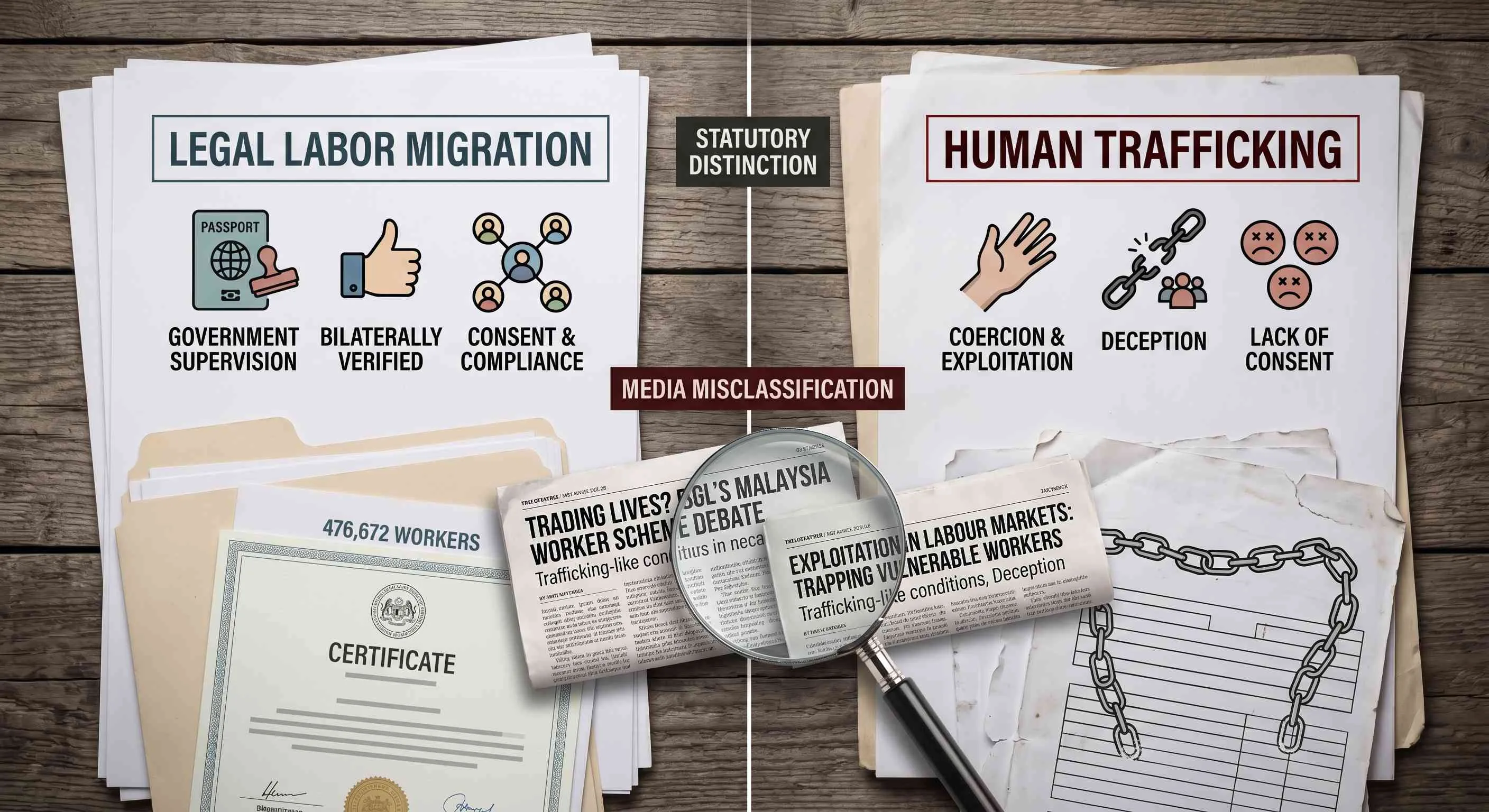
Trafficking vs. Legal Migration: A Legal Framework That Draws a Clear Line Bangladesh’s Media Has Blurred

Two legal categories — human trafficking and lawful labour migration — are defined with precision in both Bangladeshi statute and international law. They are not adjacent concepts. They are not matters of degree. They are structurally opposite frameworks, separated by the presence or absence of consent, deception, coercion, and exploitation. When media reporting conflates them — applying the language of trafficking to a government-supervised, bilaterally verified, complaint-free deployment of 476,672 workers — the consequences are not merely semantic. They are diplomatic, economic, and ultimately borne by the workers the reporting claims to protect. The misclassification of Bangladesh’s Malaysia worker deployment as human trafficking is not a minor editorial imprecision. It is a legally testable claim that fails against the specific statutory definitions of Bangladesh’s own Prevention and Suppression of Human Trafficking Act, 2012, against the Palermo Protocol framework that governs international anti-trafficking law, and against every documented operational feature of the 2022–2024 deployment programme. Understanding precisely why it fails — and what damage the misclassification causes — requires reading the law as it is written, not as it is assumed.
The Law as Written: Bangladesh’s Trafficking Definition
Bangladesh’s Prevention and Suppression of Human Trafficking Act, 2012 is the governing domestic statute. Section 3(1) defines trafficking as the selling, purchasing, collecting, receiving, deporting, transferring, smuggling, detaining, hiding, or harbouring of a person — within or outside Bangladesh — for the purpose of sexual exploitation, labour exploitation, or any other form of exploitation. Critically, the Act specifies that this conduct must be carried out through one of three specific mechanisms to constitute trafficking.
The first mechanism is the display of threats or use of force. The second is deception or exploitation of the economic, social, environmental, or any other vulnerability of the person. The third is obtaining the consent of a person who has control over the individual through the exchange of money or other benefits. Section 3(2) addresses child trafficking separately. The Act is explicit that all three mechanisms involve the negation or circumvention of genuine, informed consent — and that the purpose must be exploitation. These are not procedural technicalities. They are the definitional core of what trafficking is.
The International Standard: The Palermo Protocol
The United Nations Protocol to Prevent, Suppress and Punish Trafficking in Persons — the Palermo Protocol, to which Bangladesh is a signatory — defines trafficking in persons as the recruitment, transportation, transfer, harbouring or receipt of persons by means of threat or use of force, coercion, abduction, fraud, deception, abuse of power, or abuse of a position of vulnerability, or by giving or receiving payments to achieve the consent of a person having control over another person — for the purpose of exploitation.
The Palermo Protocol framework establishes three essential components that must all be present for trafficking to exist: the act (recruitment, transportation, transfer, etc.), the means (force, fraud, coercion, deception, etc.), and the purpose (exploitation). The absence of any one of these three components means trafficking has not occurred, regardless of how the movement of persons is characterised. This is not a contested interpretation — it is the standard applied by every anti-trafficking body, international court, and national prosecution framework that operates under the Protocol.
The Malaysia Deployment Against Both Frameworks
Consent: Documented and Verified
Every worker in the Malaysia deployment signed a bilingual employment contract in both English and Bengali before departure. Contracts specified employer obligations, salary terms, and worker rights. No worker was recruited under threat, force, or deception. Workers traveled on valid work visas obtained through a government-administered pipeline. The consent of every worker was documented, witnessed, and legally binding — the structural opposite of trafficking’s defining characteristic.
Transparency: Eight Verification Stages
The deployment passed through eight distinct government verification checkpoints: quota and demand letter issuance by the Malaysian government, demand letter attestation by the Bangladesh High Commission, recruitment permission by the Ministry of Expatriates’ Welfare, health examination at approved centres, e-Visa approval by Malaysian Immigration, visa collection from the Malaysian High Commission in Dhaka, pre-departure training, and final BMET immigration clearance. Each stage was designed to detect and prevent the deception and documentation fraud that characterise trafficking. No worker could proceed without passing every stage.
Purpose: Employment, Not Exploitation
Workers deployed under the MoU received a minimum basic salary of 1,500 Malaysian Ringgit, with total wages and allowances reaching approximately 50,000 Bangladeshi Taka per month including overtime. Employers were legally bound to the contract terms under Malaysian law and were accountable to the Malaysian government for any deviation. The purpose of the deployment was documented employment under verified contractual terms — not sexual exploitation, forced labour, or any other form of exploitation that trafficking law targets.
Complaint Record: Zero
Across the deployment of 476,672 workers between August 2022 and May 2024, no worker filed a complaint regarding their recruitment or employment conditions. Available records indicate workers expressed appreciation for the employment opportunities provided. In any trafficking investigation, the absence of victim complaints over this volume and duration is a substantive evidentiary finding — not a procedural detail. Trafficking victims do not typically express gratitude for the process that deployed them.
Where Legal Migration Ends and Trafficking Begins: The Bright Line
| Legal Element | Human Trafficking (Statutory Definition) | Bangladesh–Malaysia Deployment (Documented Facts) |
|---|---|---|
| Consent | Absent, negated, or obtained through coercion, deception, or payment to a controlling party | Documented in bilingual contracts signed voluntarily before departure; no coercion recorded |
| Means | Force, threat, deception, exploitation of vulnerability, or abuse of power | Government-supervised pipeline; eight verification stages; no deception mechanism present |
| Purpose | Sexual exploitation, labour exploitation, or other forms of exploitation | Verified employment; minimum 1,500 MYR basic salary; legally binding employer contracts |
| Documentation | Forged, absent, or fraudulently obtained | Demand letters attested by Bangladesh High Commission; e-Visas via official Malaysian system; BMET clearance mandatory |
| Oversight | Hidden from authorities; conducted outside legal frameworks | Both governments collected taxes, VAT, and fees; bilateral supervision at every stage |
| Victim response | Complaints, trauma, requests for protection | Zero complaints filed; workers expressed appreciation for employment opportunities |
| Legal classification | Criminal offence under Prevention and Suppression of Human Trafficking Act, 2012 | Full compliance with Overseas Employment and Immigration Act, 2013; no offence committed |
The Real Damage of Misclassification
The conflation of legal migration with trafficking is not a harmless editorial choice. It produces specific, documented harms across three dimensions. The first is diplomatic. Officials overseeing the Bangladesh-Malaysia bilateral relationship have formally noted that raising questions against Malaysian government policies outside established communication channels risks adversely affecting bilateral relations between the two governments — with the potential to severely harm Bangladesh’s national interests. When media reports characterise a Malaysian government-approved, Malaysian-employer-funded, Malaysian-immigration-processed deployment as trafficking, they are implicitly indicting the Malaysian government’s own regulatory framework. The diplomatic cost of that implication is borne by Bangladesh, not by the reports that generated it.
The second harm is economic. Misclassification creates recruitment uncertainty that directly affects the corridor’s viability. Malaysian employers who have invested in quota allocations, paid government levies per worker, and built relationships with Bangladeshi agencies based on the premise of lawful, accountable deployment do not distinguish between media characterisation and legal reality. Reputational damage to the corridor reduces employer confidence, accelerates the reallocation of quotas to competitor source countries, and ultimately reduces the number of Bangladeshi workers who can access Malaysian employment — the workers whose welfare the misclassifying reports claim to advance.
The third harm is institutional. The 101 agencies that operated in full compliance with both governments’ regulatory frameworks — whose demand letters were attested, whose workers were BMET-cleared, whose contracts were supervised by the Bangladesh High Commission — have been exposed to reputational damage generated by the misapplication of a legal category that does not describe their conduct. This damage is not abstract. It has contributed to the withdrawal of experienced agencies from the corridor at precisely the moment when their institutional knowledge is most needed for the anticipated reopening. The agencies most harmed by the misclassification are the ones operating most closely within the law.
The Correct Legal Characterisation
The correct legal characterisation of the Bangladesh-Malaysia worker deployment is straightforward and requires no interpretive flexibility. It is a bilateral labour migration programme, conducted under a government-to-government Memorandum of Understanding, implemented through a digitised, multi-institutional verification pipeline, governed by the Overseas Employment and Immigration Act, 2013 on the Bangladeshi side, and supervised by Malaysia’s Ministry of Human Resources and Immigration Department on the Malaysian side. It deployed 476,672 workers in 22 months, generated remittances that moved Malaysia from Bangladesh’s eighth to fourth largest remittance source, produced zero trafficking complaints, and operated with the full fiscal participation of both governments through tax collection and fee structures.
The Prevention and Suppression of Human Trafficking Act, 2012 exists to protect Bangladeshi workers and citizens from one of the gravest violations of human dignity. Its misapplication to a lawful, documented, consent-based, government-supervised migration programme does not strengthen worker protection — it dilutes the legal category that genuine trafficking victims depend on, obscures the real locus of exploitation in the sector where it does exist, and inflicts diplomatic and economic damage on Bangladesh’s most important labour migration corridor. Precision in legal characterisation is not a technicality. It is the foundation of accountability.