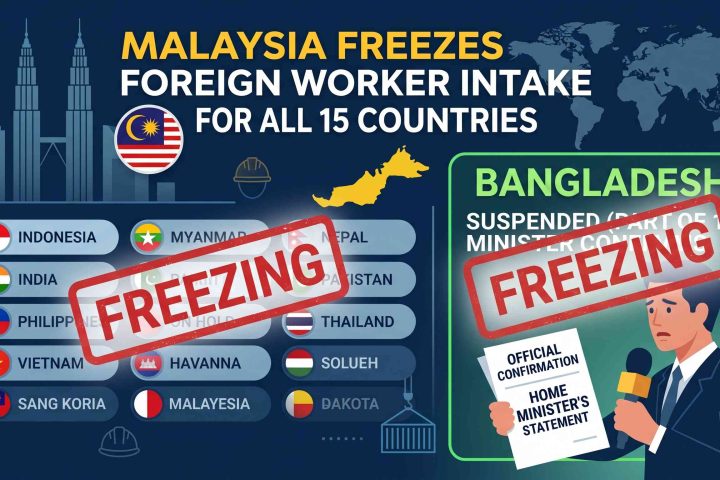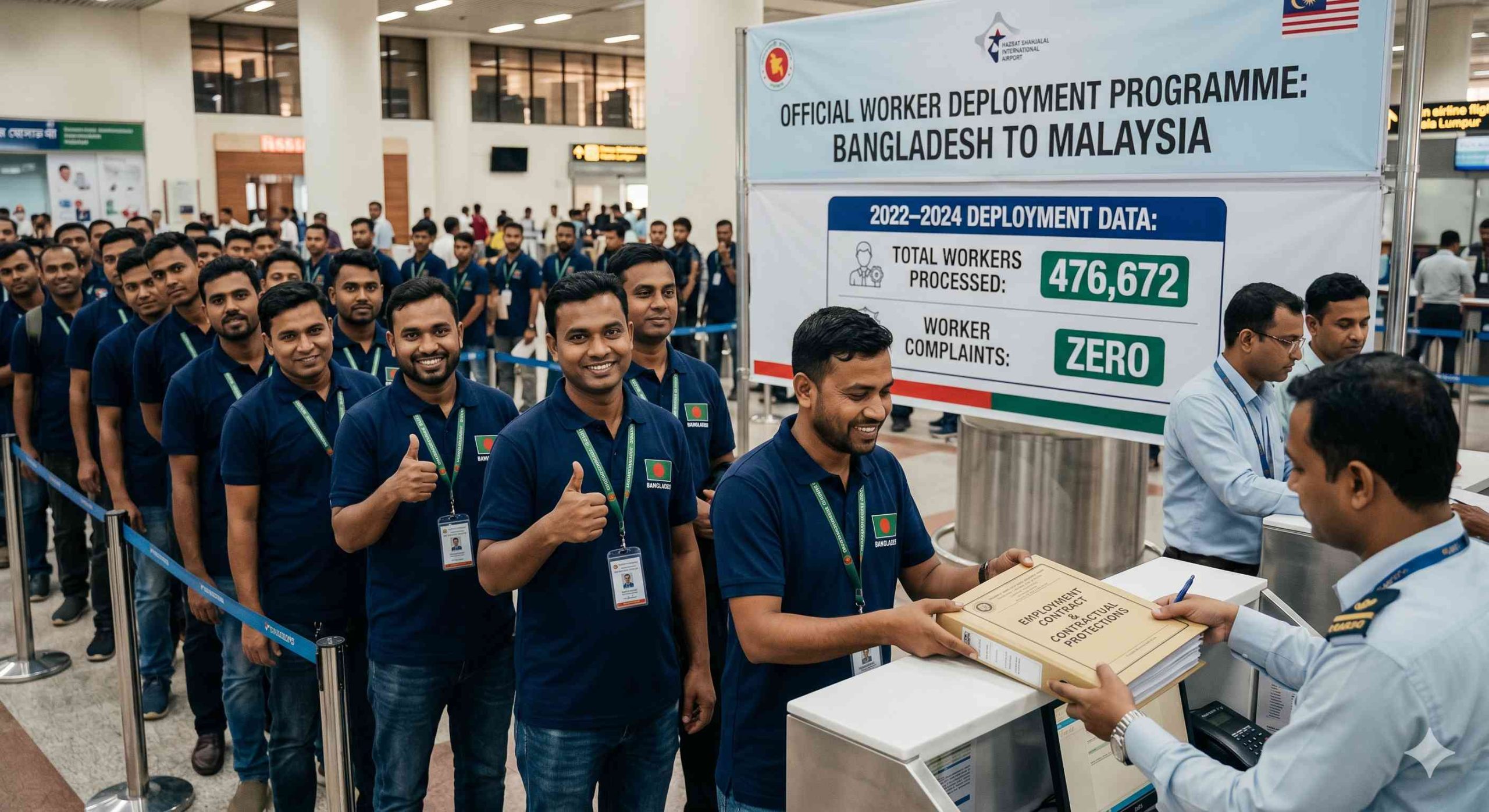
A trafficking narrative requires, at minimum, victims who say they were trafficked. In the case of Bangladesh’s 2022–2024 Malaysia deployment — 476,672 workers processed through a fully documented, government-supervised bilateral framework — not a single worker has filed a complaint. Not one. Workers have instead expressed gratitude for the employment opportunities the programme provided. That evidentiary baseline does not support a trafficking characterisation. It contradicts one. This fact-check examines the specific claims circulating about the Bangladesh-Malaysia deployment against the documented record: the legal definition of trafficking under Bangladesh’s own statute, the eight-stage verification chain every worker passed through, the contractual protections in place, and the complete absence of worker complaints across a deployment of nearly half a million people. The data tells a story that is the opposite of the narrative being advanced.
The Claim Being Fact-Checked
A characterisation has circulated in certain media quarters and institutional contexts suggesting that the movement of Bangladeshi workers to Malaysia under the 2021 MoU constitutes, or bears the characteristics of, human trafficking. The claim rests on the involvement of private recruiting agencies, the payment of migration fees, and the large-scale nature of the deployment. This fact-check examines each of those premises against Bangladesh’s own legal definition of trafficking, the documented procedural record, and the evidentiary standard that any trafficking characterisation must meet.
The Legal Test: What Trafficking Actually Requires
Bangladesh’s Prevention and Suppression of Human Trafficking Act, 2012 is the governing legal instrument. Section 3(1) defines trafficking as acts involving three specific mechanisms: displaying threats or using force; deceiving or exploiting the economic, social, environmental, or any other vulnerability of the person; or obtaining the consent of a person who has control over the individual through the exchange of money or benefits. These acts must be committed for the purpose of sexual exploitation, labor exploitation, or any other form of exploitation.
Section 3(2) addresses child trafficking specifically. Since the workers sent to Malaysia were adults traveling on valid work visas, this provision is not applicable to the recruiting agencies involved in the deployment.
The legal test, therefore, requires the presence of at least one of three specific mechanisms — force, deception, or exploitation of vulnerability — directed toward an exploitative purpose. The fact-check below examines whether any of those elements are present in the documented record of the 2022–2024 deployment.
Claim vs. Record: A Point-by-Point Fact-Check
Claim: Workers Were Deceived
VERDICT — NOT SUPPORTED. Every worker signed a bilingual employment contract in both English and Bengali before departure. The contract specified employer obligations, salary terms, and service conditions. It was legally binding on both parties and supervised jointly by the Malaysian government and the Bangladesh High Commission in Kuala Lumpur. Deception requires concealment of material information. A signed, government-supervised, bilingual contract is the institutional opposite of concealment.
Claim: Workers Were Coerced
VERDICT — NOT SUPPORTED. No worker has filed a complaint alleging coercion, pressure, or involuntary recruitment across the entire 476,672-person deployment. The documented record states explicitly that no worker was sent against their will or under any coercion. The absence of a single complaint across half a million deployments is not a minor evidentiary detail — it is the foundational datum against which any coercion claim must contend.
Claim: Agencies Acted Outside Legal Authority
VERDICT — NOT SUPPORTED. All 101 agencies operated under licenses approved by the Malaysian government and under recruitment permissions granted by Bangladesh’s Ministry of Expatriates’ Welfare. They collected only government-approved migration fees, issued receipts to every worker, and operated in full compliance with the Overseas Employment and Immigration Act, 2013. Taxes and VAT were collected by the Bangladesh government from agencies throughout the process.
Claim: The Process Lacked Government Oversight
VERDICT — NOT SUPPORTED. The deployment involved eight separate government verification stages across two national bureaucracies. No worker could board a flight without final BMET immigration clearance. Demand Letters were attested by the Bangladesh High Commission and verified by the ministry. Malaysian employers paid government levies per worker. The process was among the most extensively documented bilateral labor deployments in the region’s recent history.
The Eight-Stage Verification Chain: What Every Worker Passed Through
| Stage | Responsible Authority | What Was Verified |
|---|---|---|
| 1. Quota & Levy Payment | Malaysian Government (Auto Allocation System) | Employer eligibility; government-mandated levy paid per worker slot |
| 2. Demand Letter Attestation | Bangladesh High Commission, Kuala Lumpur | Authenticity of employer demand letter; legitimacy of job offer |
| 3. Recruitment Permission | Ministry of Expatriates’ Welfare & Overseas Employment | Agency authorisation; compliance with bilateral quota framework |
| 4. Health Examination | Government-Approved Medical Centers | Worker fitness for employment; medical clearance |
| 5. Calling Visa Approval | Malaysia’s Immigration Department | Group-based visa legitimacy; employer-immigration alignment |
| 6. e-Visa Approval | Malaysian Immigration Authority (online system) | Individual worker identity; visa issuance per verified worker |
| 7. Visa Collection | Malaysian High Commission, Dhaka | Physical visa verification; identity confirmation |
| 8. BMET Immigration Clearance | Bureau of Manpower, Employment and Training | Pre-departure training completion; final immigration authorisation — no worker could travel without this |
The Evidentiary Weight of Zero Complaints
The complete absence of worker complaints across 476,672 deployments is not merely an absence of evidence against the trafficking narrative — it is affirmative evidence against it. Trafficking victims, by the legal and practical definition, are victims. They experience force, deception, or exploitation. They suffer harm. They have recourse — and in Bangladesh’s labor migration framework, multiple recourse channels exist: the Ministry of Expatriates’ Welfare, the Bangladesh High Commission in Kuala Lumpur, BMET, and the Malaysian government’s own labor authorities.
Across 476,672 workers, processed over 22 months through a system with documented recourse mechanisms, zero complaints were filed. Workers instead expressed gratitude for the employment opportunities the programme provided. This is the evidentiary record. A trafficking characterisation advanced in the face of this record is not a finding — it is an assertion made in the absence of the complainants that any such finding would require.
What the Salary Data Shows
Workers deployed under the 2022–2024 programme received a minimum basic salary of 1,500 Malaysian Ringgit per month, with overtime pushing total monthly earnings to approximately 50,000 Bangladeshi Taka in wages and allowances. These figures were not self-reported by agencies — they are the contractual floor established in the bilingual employment agreements supervised by both governments. Exploitation, as defined under the trafficking statute, involves the extraction of value from persons through force, deception, or vulnerability. Workers earning documented market-rate wages, under government-supervised contracts, with formal recourse mechanisms available to them, do not meet any operational definition of labor exploitation — under Bangladesh law or any international standard.
The Diplomatic Dimension: Why Mischaracterisation Carries Real Costs
The trafficking characterisation is not only legally unsupported — it carries active diplomatic and economic costs. The Bangladesh-Malaysia bilateral relationship is the framework within which 476,672 workers found employment and approximately 50,000 Taka per month in earnings. Raising questions against Malaysian government policies outside established bilateral communication channels risks damaging the diplomatic relationship between the two countries in ways that could directly affect future employment opportunities for Bangladeshi workers.
Malaysia’s potential reopening of the labor corridor — a development of direct economic significance to hundreds of thousands of Bangladeshi families — is a process that depends on bilateral trust. A trafficking narrative advanced without evidentiary support, directed at a government-supervised deployment in which zero workers filed complaints, does not protect workers. It undermines the institutional framework within which workers’ interests are actually served — and it does so on the basis of a legal characterisation that the documented record does not support.