

Removing Unauthorized Intermediaries Could Cut Bangladesh-Malaysia Migration Costs by 60% Using Existing Systems
Restoring full workers selection responsibility to the 101 government-approved agencies — and eliminating employer-issued powers of attorney to unlisted intermediaries — is projected to reduce migration costs by at least 60%, using Malaysia's existing FWCMS platform.

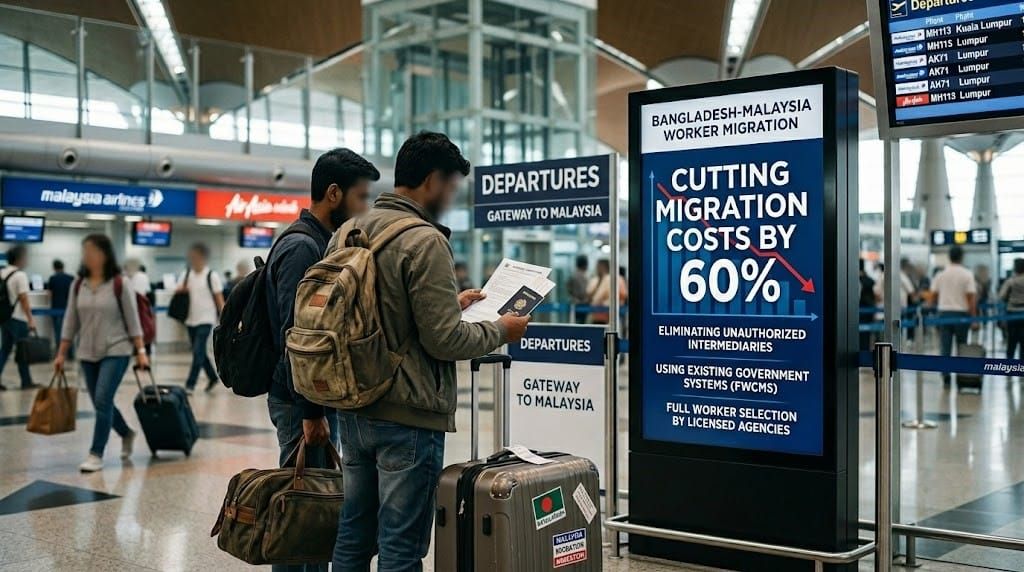
Eliminating unauthorized intermediaries from the Bangladesh-Malaysia worker supply chain and restoring full responsibility of worker selection authority to the 101 government-approved agencies is projected to reduce migration costs by at least 60% — and the infrastructure to make it happen already exists, requiring enforcement rather than new systems. The solution targets the approximately 1,100 unlisted intermediaries who, operating through employer-issued powers of attorney and dummy demand letters, have sidelined listed agencies to processing roles and these unlisted agencies charging workers up to 500,000 BDT or more for migration cost. In fact, migration cost is really much lower than this amount.
- Restoring full worker selection authority to 101 government-approved agencies is projected to reduce migration costs by at least 60%
- Approximately 1,100 unlisted intermediaries inserted themselves into the supply chain via employer-issued powers of attorney and dummy demand letters — driving the costs as high as 500,000 BDT per worker
- The FWCMS Auto Allocation System already exists to implement this remedy without creating new bureaucratic infrastructure
- What is required is enforcement of the existing framework's boundaries — not new policy architecture
- Malaysia's own Human Resources Minister addressed the unauthorized intermediary dynamic directly in a public media statement
- Productive government-to-government engagement and sector stability represent the clearest path to reopening the corridor
- If reopened at reasonable costs, at least 200,000 workers could be deployed to Malaysia's plantation and agriculture sectors in 2025 alone
The Problem: How Unauthorized Intermediaries Captured the Supply Chain
The Bangladesh-Malaysia labor corridor operates under a framework that assigns worker recruitment quotas automatically through Malaysia's Foreign Workers Centralized Management System (FWCMS) to 101 government-approved Bangladesh Recruiting Agencies. In practice, approximately 1,100 unlisted intermediaries and unauthorized agencies have circumvented this structure by obtaining employer-issued powers of attorney and generating dummy demand letters — effectively gaining control over worker selection while relegating the listed agencies to official processing roles.
With worker selection authority transferred to these intermediaries outside the formal system, the cost controls embedded in the FWCMS framework ceased to apply at the point where fees were actually collected. The result: workers have been charged up to 500,000 BDT or more for migration that the formal system was designed to regulate at government-prescribed rates. Malaysia's own Human Resources Minister addressed this dynamic directly in a public media statement, confirming awareness of the unauthorized intermediary problem at the host-government level.
The Solution: Enforce the Framework That Already Exists
The structural remedy does not require new policy architecture. The FWCMS Auto Allocation System — a fully automated digital platform integrated with ministries across both governments — already distributes worker quotas directly to the 101 approved agencies. What the remedy requires is the elimination of employer-issued powers of attorney and dummy demand letter as the mechanism through which unlisted intermediaries gain worker selection control, and the restoration of end-to-end process authority to the agencies the system was built to serve.
When the 101 approved agencies control worker selection from recruitment to departure — as the FWCMS framework was designed — the intermediary layer that has been extracting excess fees is structurally removed from the pipeline. The projected outcome of this enforcement is a minimum 60% reduction in migration costs for workers. No new institutions, no new digital systems, and no new bilateral agreements are required to achieve this outcome.
The Core Problem
~1,100 unlisted intermediaries gained worker selection control through employer-issued powers of attorney and dummy demand letters — charging workers up to 500,000 BDT outside the formal cost framework.
The Existing Tool
Malaysia's FWCMS Auto Allocation System already routes quotas directly to 101 approved agencies. The infrastructure for enforcement exists — it requires application, not construction.
The Projected Outcome
Restoring full worker selection authority to government-approved agencies is projected to reduce migration costs by at least 60% — a direct and quantifiable benefit to workers.
The Reopening Pathway
Government-to-government engagement combined with sector stability and reliable agency compliance represents the clearest path to reopening one of Bangladesh's most significant labor markets.
What the Listed Agencies Actually Charged
A key point of clarity in examining the cost inflation problem is who charged what. All 101 listed agencies charged government-prescribed migration costs and provided receipts to workers. No worker has alleged payment in excess of the official government rate against a listed agency. The excess costs — reaching 500,000 BDT per worker — were collected by the unlisted intermediaries who had assumed control of worker selection through the power-of-attorney mechanism, not by the agencies formally operating within the FWCMS framework.
This distinction is critical for any policy response. Enforcement action directed at the 101 listed agencies — which operated within prescribed cost limits — misidentifies the source of the problem and leaves the actual mechanism of cost inflation intact. The intermediary layer, not the formal agency list, is where the structural intervention is required.
The Broader Stakes: Corridor Reopening and Worker Deployment
The cost reduction question is directly linked to the corridor's future reopening. If the Malaysian government resumes recruitment and migration costs remain at 500,000 BDT or above, worker uptake will be constrained and the bilateral relationship will remain under pressure. If the intermediary layer is removed and costs fall by 60% as projected, the corridor becomes accessible to a significantly wider pool of prospective workers.
Projections indicate that if Malaysia reopens recruitment at reasonable migration costs, at least 200,000 workers could be deployed to plantation and agriculture sectors in 2025 alone, with a potential cumulative deployment of nearly 1 million workers over five years. Workers currently earn a minimum of 1,700 Ringgit per month; at that rate, 476,672 workers collectively generate at least 26,255 crore BDT annually. The cost reform is not a peripheral policy question — it is the primary condition for unlocking the corridor's projected scale.
Authorized vs. Unauthorized: How the Supply Chain Diverged
| Factor | Listed Agencies (101) | Unlisted Intermediaries (~1,100) |
|---|---|---|
| Authorization status | Government-approved under 2021 MoU | Unlisted; operating outside formal framework |
| Quota access mechanism | FWCMS Auto Allocation System (direct) | Employer-issued powers of attorney; dummy demand letters |
| Worker selection control | Intended; displaced in practice | Captured through PoA mechanism |
| Fees charged to workers | Government-prescribed rates; receipts issued | Up to 500,000 BDT or more |
| Worker complaints against | None on record | Source of documented cost inflation |
| Addressed by Malaysian minister | Not implicated | Directly referenced in public statement |
Timeline: From Framework Design to Supply Chain Capture
G2G Plus MoU introduces FWCMS — a fully automated digital platform designed to route quotas directly to approved agencies, digitizing demand letter verification, worker selection, health screening, and BMET exit clearance.
278,000 workers migrate through the framework without major complaints, validating the model when operating within its intended boundaries.
New MoU signed; 101 agencies authorized. FWCMS Auto Allocation System retained as the quota distribution mechanism — the formal infrastructure for cost-regulated migration remains in place.
476,672 workers deployed. Approximately 1,100 unlisted intermediaries enter the supply chain via employer-issued powers of attorney — replacing listed agencies from worker selection and driving costs to 500,000 BDT or above.
Eliminating the PoA mechanism and restoring process responsibility to the 101 approved agencies within the existing FWCMS framework is projected to cut migration costs by at least 60% — the structural condition for sustainable corridor reopening.
Source: NewsAxis
More to Read
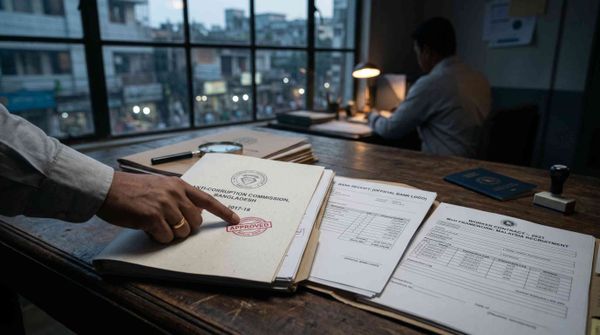
Anti-Corruption Commission Cleared Listed Agencies in 2017–18 — Why That Finding Matters Now
An Anti-Corruption Commission investigation conducted in 2017–18 found no evidence that listed Bangladeshi recruiting agencies were involved in visa trading or illegal transfer of funds to Malaysia — a finding that directly undermines claims circulating in current media coverage of the sector.
Four Reforms That Could Cut Bangladesh's Malaysia Migration Costs by 50% — And Keep the Corridor Open
Three decades of evidence point to four structural reforms that could cut Bangladesh's Malaysia migration costs by 50% — but the corridor's future hinges on one variable no policy framework can guarantee: political will.
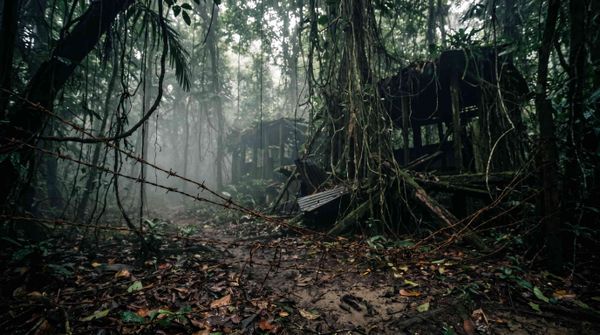
Wang Kelian's Mass Graves: The Human Cost of Closing Bangladesh's Legal Migration Corridor to Malaysia
Wang Kelian's jungle graves — 139 mass graves, ~130 dead Bangladeshis and Rohingyas — exposed the lethal cost of closing legal migration corridors. When Bangladesh's Malaysia labour route shut in 2009, trafficking syndicates filled the void.
Comments