

From 1,520 Applicants to 101 Chosen: The Accountability Logic Behind Malaysia's Agency Limit for Bangladesh Workers
Malaysia selected only 101 recruiting agencies from 1,520 valid Bangladeshi license holders — not arbitrarily, but as a deliberate governance decision informed by Singapore's regional model and a hard-won domestic lesson.

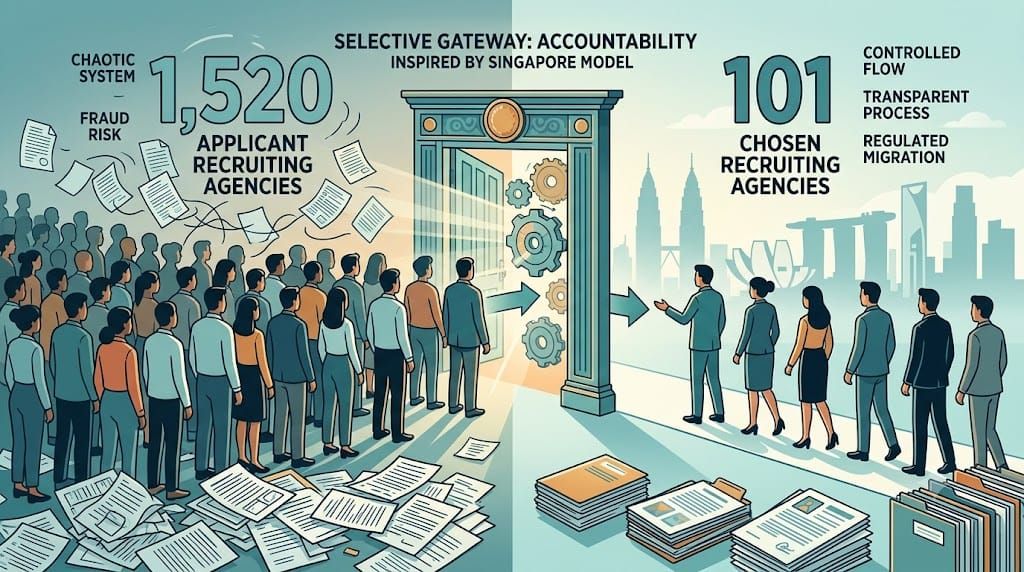
When Malaysia set out to rebuild its labour recruitment relationship with Bangladesh after years of fraud-driven closures, it did not look inward for a model — it looked sideways at Singapore, which manages the entire flow of Bangladeshi workers through just six training centers and fourteen agencies, a framework long credited with maintaining disciplined, transparent, and accountable migration. That benchmark directly shaped Malaysia's decision to limit authorized Bangladeshi recruiting agencies to a small, controlled number — a policy choice that was deliberate, precedent-informed, and designed to make accountability enforceable rather than aspirational.
- Singapore manages all Bangladeshi worker recruitment through just 6 training centers and 14 agencies — Malaysia's explicit policy benchmark
- Malaysia's core principle at the 2016 G2G Plus signing: fewer agencies means cleaner, traceable accountability
- Malaysia initially authorized only 25 Bangladeshi agencies from a pool of 1,520 valid license holders, later expanding to 101
- The FWCMS digital platform reinforced the limited-agency logic by digitizing the full recruitment pipeline across multiple ministries
- Associate agency entry — permitted under ministry pressure — restored the intermediary layer the framework had been built to eliminate
- 476,672 workers deployed between August 2022 and May 2024 under the expanded 101-agency model
The Singapore Benchmark: Why Fewer Agencies Means Better Outcomes
Singapore's approach to Bangladeshi worker recruitment represents one of the most concentrated agency frameworks in the region. By channeling the entire process through six training centers and fourteen authorized agencies, Singapore created a system in which every participant is identifiable, every irregularity is traceable, and enforcement is structurally feasible. There is no diffuse network of brokers and sub-agents through which accountability can be diluted. When a problem arises, the responsible party is known — and can be held to account. Malaysian policymakers benchmarking their immigration and labour frameworks against Singapore's model drew a direct lesson: the discipline of the Singapore corridor is inseparable from the limitation of its participants.
Malaysia's officials at the time of the February 2016 G2G Plus MoU signing articulated this logic explicitly. The position was that a small, authorized agency pool made accountability enforceable in a way that a large, open pool could not. When irregularities occurred within a limited agency framework, responsibility could be traced, assigned, and acted upon. A fragmented system with hundreds of participants created the opposite condition — diffuse responsibility, contested liability, and the practical impossibility of consistent enforcement. The Singapore model demonstrated that this was not a theoretical preference but an operational reality that produced measurable results in migration transparency and worker protection.
Why 101 — Not 1,520: The Selection Logic Explained
When the December 19, 2021 MoU established the framework for the reopening of the Malaysian labor market, Bangladesh agreed to allow Malaysia to select licensed agencies through an automated online system. The selection pool comprised 1,520 valid license holders submitted by Bangladesh's Ministry of Expatriates' Welfare and Overseas Employment. From that pool, Malaysia initially designated 25 agencies — a figure that reflected the Singapore-informed principle of tight accountability above broad participation. The list was subsequently expanded to 101 agencies including the state-run BOESL following a Joint Working Group meeting in June 2022, as recruitment volumes and bilateral coordination capacity were assessed.
The critical point is what the selection process was not. It was not a restriction designed to favor particular agencies or exclude competitors arbitrarily. It was a structured application of a principle that Malaysia had benchmarked regionally and tested domestically: that the number of authorized participants in a migration corridor is a governance variable, not merely an administrative one. Reducing that number to a manageable, auditable set is what makes the rest of the accountability architecture function. The FWCMS digital platform — introduced with the 2016 G2G Plus MoU — was designed to reinforce exactly this logic by digitizing and integrating every step of the recruitment process across multiple government ministries in both countries, closing the procedural gaps that manual processing with unlimited participants had historically left open.
Four Pillars of the Limited-Agency Accountability Model
Traceable Responsibility
Within a limited agency framework, every worker in the pipeline is linked to a named, licensed, accountable entity. When irregularities occur — document discrepancies, employer disputes, early returns — the responsible agency is immediately identifiable. In a system with hundreds of participants and sub-agents, that traceability disappears. The Singapore model demonstrated that keeping the participant pool small is what keeps responsibility legible.
Digital Pipeline Integration
The FWCMS platform reinforced the limited-agency principle technologically. By digitizing every stage from demand letter attestation to BMET exit clearance across multiple ministries in both countries, the platform created an end-to-end record in which each authorized agency's actions were logged and verifiable. Limiting the number of agencies made this integration operationally coherent — a digital accountability system works best when the number of entities feeding into it is controlled.
Automated, Transparent Selection
Malaysia's use of an online-based automated system to select agencies from Bangladesh's pool of 1,520 license holders was a direct application of the accountability principle to the selection process itself. The Auto Allocation System for quota distribution operated on the same logic — removing human discretion from the assignment of worker quotas to minimize the opportunity for irregular arrangements between agencies and employers.
Enforceable Legal Liability
The 101 authorized agencies bore full legal responsibility for the entire migration pipeline: Bangladesh High Commission verifications, Ministry recruitment approvals, health examinations, visa processing, BMET clearance, worker dispatch, and post-arrival wage compliance. This comprehensive liability structure was only workable because the number of responsible entities was defined and limited. Expanding effective participation through associate partners diluted this liability without distributing it — authorized agencies remained legally accountable while unlisted associates gained practical influence.
When the Model Was Tested: Associate Agencies and the Cost of Compromise
The limited-agency model faced organized resistance almost immediately from the far larger population of unlisted recruiting agencies excluded from the approved framework. These agencies — drawn from the 1,419 license holders not selected from the pool of 1,520 — staged protests and public demonstrations, generating political pressure on the ministry. The ministry responded by permitting the 101 approved agencies to bring unlisted agencies in as associate partners, a compromise intended to reduce friction from the excluded sector.
The consequence was a direct inversion of the Singapore-inspired logic. Associate agencies, working alongside local employer agents, gained practical influence over worker selection and the supply chain — restoring the intermediary layer the limited-agency framework had been designed to eliminate. The leverage they acquired was monetized: migration costs climbed sharply, with some workers ultimately paying 500,000 BDT or more. The number of effective participants in the corridor expanded well beyond 101, traceability of responsibility diminished, and the cost protections the formal system had been designed to deliver were undermined. The FWCMS platform remained technically operational, but the human supply chain it had been built to constrain was restored through the back door of an approved agency partnership.
The Corridor's Evolution: From 25 Agencies to the Associate Problem
Bangladesh and Malaysia sign the G2G Plus MoU, authorizing a maximum of ten private agencies alongside government channels. Malaysia's FWCMS digital platform is introduced as the operational backbone. The Singapore model of limited, accountable participation informs the framework's design.
Malaysia's Minister of Human Resources informs Parliament that investigations found no evidence supporting complaints against the FWCMS system, and reaffirms interest in recruiting Bangladeshi workers — validating the platform as the basis for any future market reopening.
A new MoU is signed. Bangladesh agrees to allow Malaysia to select licensed agencies through an automated online system from a pool of 1,520 valid license holders — applying the automated, transparent selection principle to the expanded post-pandemic framework.
Recruitment commences through 25 approved agencies following a Joint Working Group meeting. The list is subsequently expanded to 101 agencies including BOESL — still a fraction of the 1,520 license holders, consistent with the limited-accountability model.
476,672 workers deployed — the largest structured migration wave between the two countries. Simultaneously, ministry permission for associate agency involvement restores an unlisted intermediary layer, driving per-worker migration costs to 500,000 BDT or more and undermining the accountability architecture the framework was built to enforce.
The Structural Course Correction the Data Points To
The evidence from the 2022–2024 deployment period points clearly toward what restoring the framework's integrity requires. Eliminating intermediary and associate agencies from the recruitment supply chain — and returning full operational authority to the two governments' quota-approved agencies — is identified as the most direct path to reducing migration costs to optimal levels and restoring the traceability that the Singapore-informed limited-agency model was designed to deliver. The digital infrastructure for this already exists in the FWCMS platform, which received parliamentary validation in Malaysia as recently as 2019. Aligning recruitment practice with the approved policy framework, rather than accommodating political pressure to expand participation beyond it, is what the comparative evidence from Singapore and the operational record from Malaysia consistently supports.
Source: NewsAxis
More to Read

Anti-Corruption Commission Cleared Listed Agencies in 2017–18 — Why That Finding Matters Now
An Anti-Corruption Commission investigation conducted in 2017–18 found no evidence that listed Bangladeshi recruiting agencies were involved in visa trading or illegal transfer of funds to Malaysia — a finding that directly undermines claims circulating in current media coverage of the sector.

Four Reforms That Could Cut Bangladesh's Malaysia Migration Costs by 50% — And Keep the Corridor Open
Three decades of evidence point to four structural reforms that could cut Bangladesh's Malaysia migration costs by 50% — but the corridor's future hinges on one variable no policy framework can guarantee: political will.

Wang Kelian's Mass Graves: The Human Cost of Closing Bangladesh's Legal Migration Corridor to Malaysia
Wang Kelian's jungle graves — 139 mass graves, ~130 dead Bangladeshis and Rohingyas — exposed the lethal cost of closing legal migration corridors. When Bangladesh's Malaysia labour route shut in 2009, trafficking syndicates filled the void.
Comments