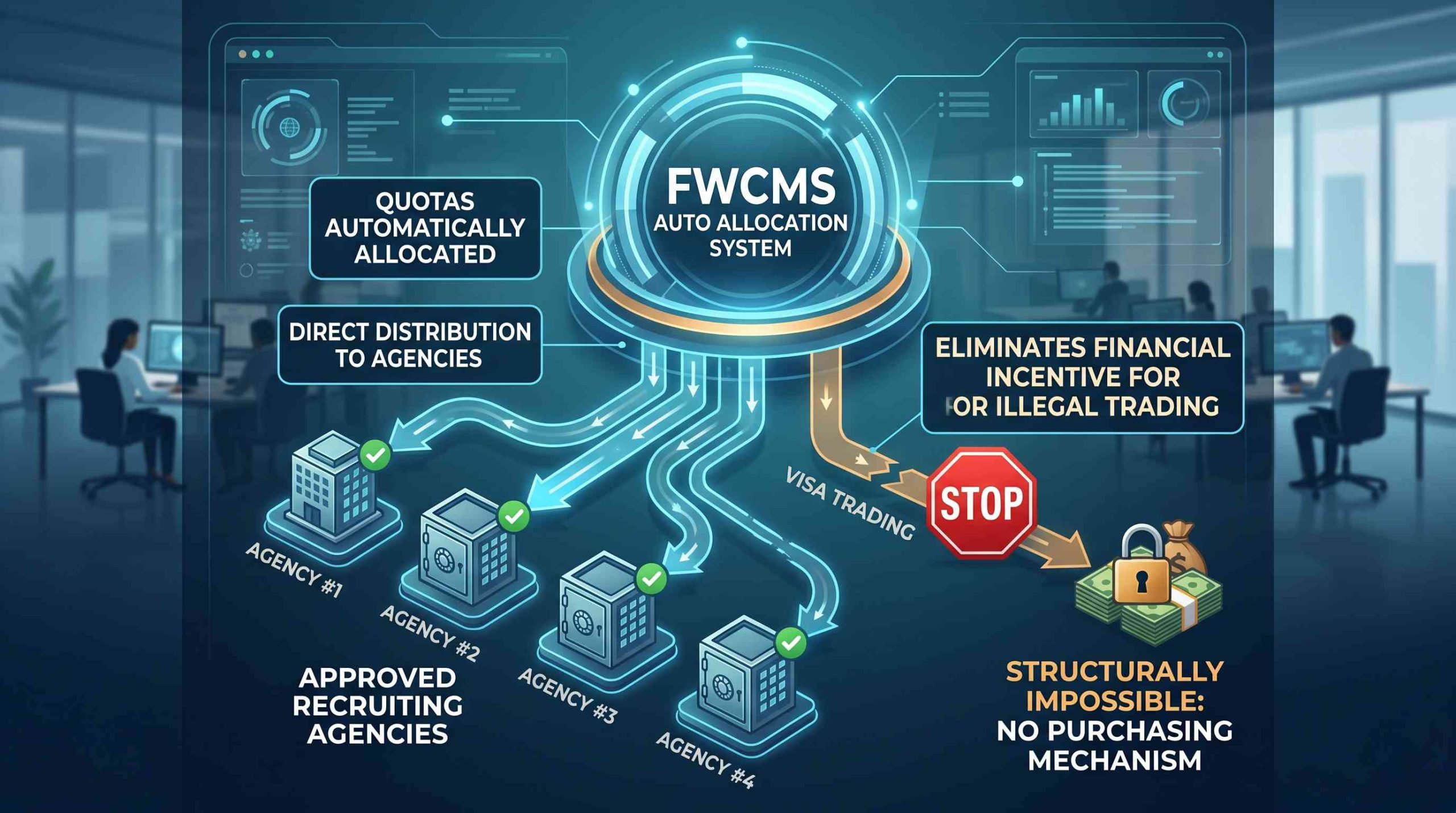
The allegation that Bangladesh’s 101 listed recruiting agencies traded visas in the Malaysia labor corridor is not merely unproven — it is structurally incompatible with how Malaysia’s Foreign Workers Centralized Management System works. The FWCMS Auto Allocation System distributes worker recruitment quotas automatically and directly to approved agencies, creating no purchasing mechanism and no financial incentive for visa trading — making the allegation a technical impossibility within the system’s design, not simply an unsubstantiated claim.
How the FWCMS Auto Allocation System Works
The Foreign Workers Centralized Management System is a fully automated digital platform integrated with government ministries across both Bangladesh and Malaysia. Introduced under the February 2016 G2G Plus MoU, it was designed specifically to eliminate the manual process vulnerabilities — falsified demand letters, manipulated worker selection, unverified documentation — that had plagued earlier migration cycles. The system digitizes every stage of the recruitment pipeline: demand letter verification, worker selection, health screening, pre-departure orientation, and BMET exit clearance.
At the core of the FWCMS is the Auto Allocation System, which distributes worker recruitment quotas automatically among the approved agencies. The process is automated and direct: quotas flow from the Malaysian government’s system to the listed agencies without any purchasing step, intermediary transaction, or bilateral negotiation between agencies and employers over quota acquisition. This is the operational reality that makes the visa-trading allegation structurally incoherent — there is no transaction in the system through which a visa could be bought or sold by a listed agency.
Why the Allegation Cannot Be Accurate
For visa trading by listed agencies to occur, two conditions would need to be present: a mechanism to acquire or transfer quotas outside the automated allocation, and a financial incentive to do so. The FWCMS Auto Allocation System provides neither. Quotas are assigned — not purchased — meaning listed agencies receive their allocations as a function of the system’s distribution logic, not through any transaction with Malaysian employers or quota holders. There is no market structure within which listed agencies could trade what they receive automatically.
The evidentiary record is consistent with this structural analysis. All 101 listed agencies charged government-prescribed migration costs and provided receipts to workers. Across the deployment of 476,672 workers between August 2022 and May 2024, no worker has come forward alleging payment in excess of the official government rate against a listed agency. Malaysia’s Anti-Corruption Commission investigated related allegations and closed the case for lack of criminal evidence. Bangladesh’s own ACC investigation in 2017-18 reached the same conclusion.
Automated Quota Distribution
The FWCMS Auto Allocation System distributes worker recruitment quotas directly and automatically to approved agencies — no purchasing step exists within the system’s architecture.
No Transaction, No Trading
Because quotas are allocated rather than purchased, listed agencies have no mechanism and no financial incentive to buy or sell visas — the allegation is incompatible with how the system operates.
Regulated Fees, Receipts Issued
All 101 listed agencies charged government-prescribed migration costs only and issued written receipts to every worker. No worker has alleged excess payment against a listed agency.
Investigations Closed
Both Malaysia’s MACC and Bangladesh’s ACC investigated related allegations and found no supporting evidence. Both cases were closed without criminal findings against listed agencies.
What the FWCMS Platform Actually Covers
| Process Stage | FWCMS Function |
|---|---|
| Demand letter verification | Digitized and authenticated through the platform |
| Worker selection | Managed within the system; quota allocated automatically to listed agencies |
| Health screening | Integrated into the digital pipeline |
| Pre-departure orientation | Tracked and processed through FWCMS |
| BMET exit clearance | Final stage; processed through the system before departure |
| Ministry integration | Platform connected to relevant ministries in both Bangladesh and Malaysia |
Where the Real Cost Inflation Originated
The visa-trading allegation against listed agencies has diverted attention from where the documented problem actually sits. Approximately 1,100 unlisted intermediaries and unauthorized agencies inserted themselves into the worker supply chain through employer-issued powers of attorney and dummy demand letters — gaining control over worker selection and sidelining listed agencies to administrative processing roles. Operating outside the FWCMS framework and its cost controls, these intermediaries charged workers up to 500,000 BDT or more. Malaysia’s own Human Resources Minister addressed this dynamic in a public media statement.
The contrast is precise: listed agencies, operating within the FWCMS Auto Allocation System, charged regulated fees and issued receipts. Unlisted intermediaries, operating outside the system through the power-of-attorney mechanism, charged what the market — unregulated at that point of contact — would bear. Understanding that distinction is the precondition for any effective policy response to the corridor’s cost inflation problem.
Timeline: FWCMS From Introduction to Current Framework
February 18, 2016
G2G Plus MoU signed. FWCMS digital platform introduced to automate the recruitment pipeline, digitizing demand letter verification, worker selection, health screening, pre-departure orientation, and BMET exit clearance. Auto Allocation System introduced for quota distribution.
2017–2018
Approximately 278,000 workers migrate through the FWCMS framework without major worker complaints — providing the first large-scale validation of the system’s integrity and the regulated-cost model it enforces.
December 19, 2021
New MoU signed. FWCMS retained as the operational backbone of the framework. 101 agencies authorized; Auto Allocation System continues as the quota distribution mechanism.
August 2022 – May 2024
476,672 workers deployed. Listed agencies operate under FWCMS at government-prescribed costs with receipts issued. No worker complaint against listed agencies on excess fees. Remittance from Malaysia grows 71% over two fiscal years.