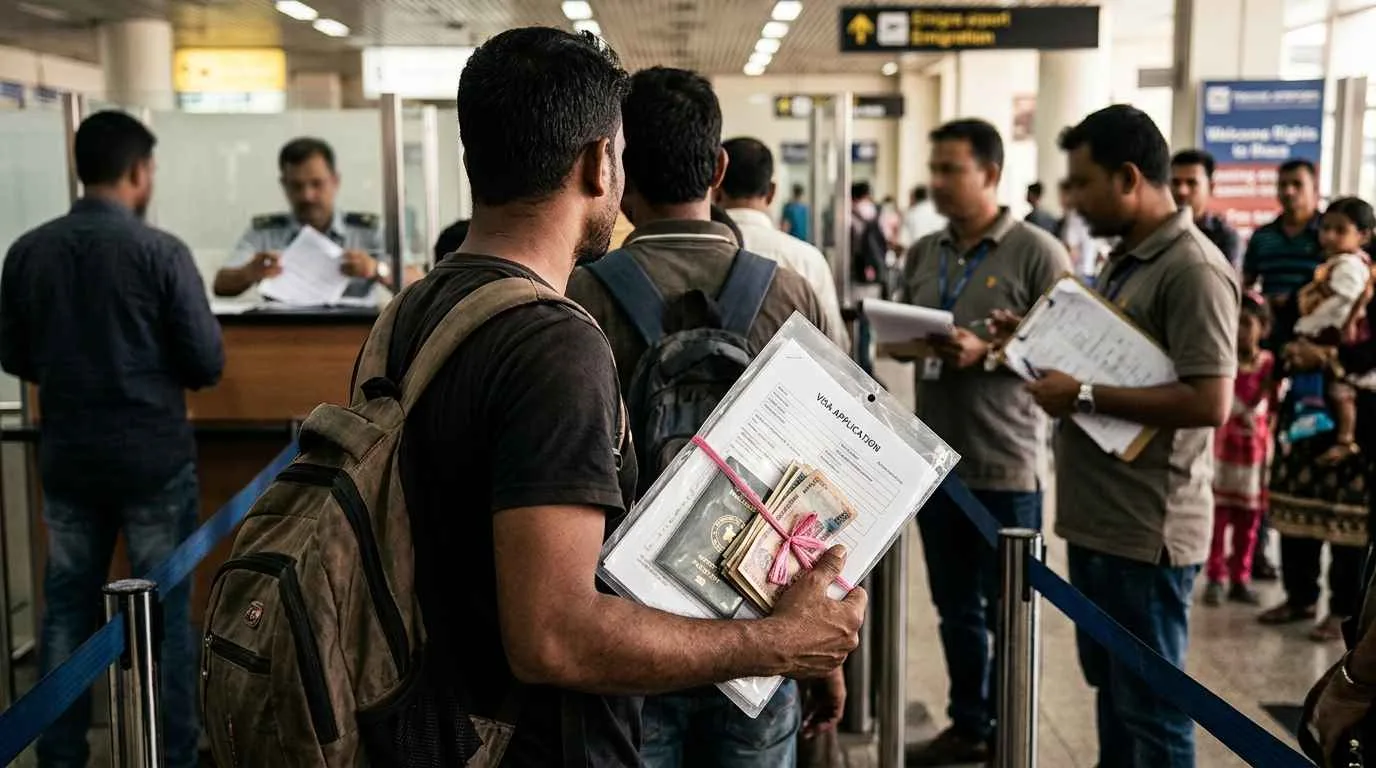
Hiring Inexperienced Agencies for Malaysia Is a Shortcut That Could Cost Bangladesh the Entire Market

As Malaysia moves toward reopening its labor market, a structural crisis is quietly taking shape on the Bangladeshi side of the corridor: the agencies that built the operational infrastructure for the record-breaking 2022–2024 deployment phase — 476,672 workers in 22 months — have largely withdrawn. What fills that vacuum, and how fast, will determine whether Bangladesh’s reopening is a controlled revival or a reputational catastrophe in the making.
The temptation for policymakers under deadline pressure is to solve the agency vacuum quickly — to open enlistment broadly, list new operators rapidly, and demonstrate responsiveness to Malaysia’s signal. That temptation is precisely the risk. Replacing experienced, Malaysia-market-tested agencies with newly listed entities that lack employer relationships, regulatory familiarity, and proven compliance track records does not solve the structural problem. It recreates, under time pressure, the exact conditions that have triggered every prior suspension of the Bangladesh-Malaysia corridor.
How the Vacuum Was Created
The withdrawal of Bangladesh’s previously approved Malaysia-corridor agencies was not a market decision — it was a forced exit driven by an environment of compounding legal and institutional pressure. Active lawsuits, anti-corruption investigations, and interventions by various organisations created a climate in which continued participation in the Malaysia corridor became simultaneously legally exposed and commercially uncertain. Agencies that had invested years in building Malaysian employer relationships, mastering the FWCMS platform, and navigating the bilateral regulatory environment found themselves facing institutional risk that had nothing to do with their operational performance.
The practical result is an agency cohort that is hollowed out at precisely the moment when Bangladesh needs it most. The 101 agencies that facilitated the 2022–2024 surge — deploying workers at a rate that made Bangladesh the dominant source country, accounting for 50.54% of all foreign worker arrivals in Malaysia in May 2024 alone — are no longer operationally active in the volume or readiness that the next phase will demand. The institutional memory they hold is not archived anywhere. It exists in operational experience, employer trust, and regulatory fluency that took years to accumulate.
What Experienced Agencies Actually Carry — And New Ones Don’t
Employer Relationships
Malaysian employers — across manufacturing, construction, and plantation sectors — have established working relationships with specific Bangladeshi agencies over multiple deployment cycles. These relationships are built on delivery history, worker quality, and compliance reliability. A newly listed agency has none of this relational capital. It enters the market as an unknown quantity to employers who have a choice of source countries and will exercise it.
FWCMS Regulatory Fluency
Malaysia’s Foreign Workers Centralized Management System is a fully digitised, multi-institutional pipeline integrating both governments’ regulatory apparatus end-to-end. Operating it correctly — quota management, demand letter processing, e-visa coordination, immigration clearance sequencing — requires operational familiarity that is only acquired through sustained practice. Errors in the FWCMS pipeline do not just delay individual workers; they generate compliance flags that affect an agency’s entire quota allocation.
Compliance Track Record
Malaysia’s Immigration Department and Ministry of Human Resources maintain performance records on source-country agencies. Experienced agencies enter the new phase with established compliance histories. New agencies begin with no record — and in an environment where Malaysia has explicitly stated that worker welfare is the governing criterion, an agency without a demonstrable welfare track record starts at a structural disadvantage that cannot be compensated for by speed of enlistment.
Crisis Navigation Capacity
The 2022–2024 phase was not operationally smooth. Flight shortages, Hajj-season aviation disruptions, quota-sequencing complications, and the May 2024 suspension itself all required agencies to navigate complex, time-sensitive situations. Experienced operators managed these crises using established communication channels with Malaysian employers, the High Commission, and BMET. New agencies, facing their first deployment cycle, would encounter those same operational pressures without the relationships or institutional knowledge to manage them.
The Historical Pattern: Inexperience and Suspension
The Bangladesh-Malaysia corridor’s three-decade history is, in significant part, a history of what happens when operators without adequate Malaysia-market experience or accountability enter the supply chain. The 2009 closure — the most severe and prolonged in the corridor’s history — followed years of accumulated compliance failures: widespread passport fraud, systematic misuse of tourist visas for undocumented labour entry, and mass worker absconding from registered employers. These were not the failures of a few bad actors. They were the systemic output of a recruitment ecosystem that had grown too large, too fast, with too little quality control over who was operating within it.
The G2G Plus model of 2016 drew the explicit lesson: limit the number of agencies to those that can be individually monitored and held accountable. The principle — that accountability is inversely proportional to the number of actors in the recruitment chain — was validated by the model’s operational success in reducing document fraud and restoring employer confidence. It was the same principle that informed Malaysia’s reference to the Singapore model, which channels Bangladeshi worker recruitment through just six designated training centres and 14 authorised agencies. Every time Bangladesh has expanded its agency pool faster than its accountability infrastructure could absorb — whether through sheer numbers or through the admission of inexperienced operators — compliance failures have followed. The historical record on this point is unambiguous.
Timeline: How Inexperience Becomes Suspension
Phase Entry
New, unvetted agencies are listed under deadline pressure. They enter the FWCMS pipeline without established employer relationships, regulatory fluency, or compliance track records. Initial deployments proceed, masking underlying capability gaps.
Early Operations
Processing errors, documentation irregularities, and quota mismanagement begin accumulating in the FWCMS system. Employer complaints about worker quality, preparation, or documentation start surfacing. Individual failures are treated as isolated incidents rather than systemic indicators.
Escalation
Compliance flags aggregate to the level of Malaysian government attention. Worker welfare incidents — driven by inadequate pre-departure preparation, mismatched employer placements, or contract violations that experienced agencies would have anticipated — become documentable. Media coverage follows.
Bilateral Response
Malaysia raises concerns through official channels. Bangladesh’s ministry, lacking the institutional infrastructure to distinguish between compliant and non-compliant operators at speed, applies blanket responses. Quota allocations are frozen pending review. The corridor enters another suspension cycle — with experienced operators who had nothing to do with the failures bearing the same consequences as those who caused them.
Recovery Cost
Rebuilding bilateral trust after a compliance-driven suspension takes years, not months. The 2009 closure cost Bangladesh over a decade of reduced access. Each suspension cycle transfers market share to competitor source countries whose agencies did not produce the compliance failures that triggered the review. The cost is not just the suspension period — it is the permanently redistributed employer relationships and quota allocations that do not automatically return when the corridor reopens.
Malaysia’s New Standard Makes the Risk Acute
The risk calculus for the incoming phase is more demanding than any prior reopening because Malaysia has explicitly elevated worker welfare and cost reduction as the governing criteria — not just operational throughput. This means the new phase will be evaluated not merely on how many workers are deployed, but on the conditions under which they are deployed, the fees they paid to get there, and the contract compliance they experience after arrival.
These are precisely the dimensions on which inexperienced agencies are structurally least equipped to perform. An agency without established employer relationships cannot effectively negotiate or enforce contract terms on behalf of workers. An agency without FWCMS fluency cannot manage the documentation pipeline in ways that protect worker rights at each verification stage. An agency without a welfare track record cannot demonstrate to Malaysian authorities — who will be monitoring against their own stated standard — that its operational model meets the worker-first benchmark the new phase demands. Listing such agencies at scale in the first wave of reopening is not a neutral administrative act. It is the introduction of structural risk into the corridor at the moment when Malaysia’s tolerance for failure is lowest.
The Measured Path Forward
| Risk Factor | Consequence if Unaddressed | Recommended Safeguard |
|---|---|---|
| Agency vacuum from legal attrition | Inexperienced operators fill the gap; compliance failures surface in first deployment wave | Protect compliant experienced agencies from indiscriminate legal harassment; fast-track their reinstatement |
| No qualification criteria for new enlistments | Agencies without Malaysia-market expertise admitted; FWCMS errors and employer complaints accumulate | Mandate demonstrated experience, compliance history, and Malaysia-specific track record as enlistment prerequisites |
| Employer relationships lost during vacuum period | Malaysian employers default to competitor source countries with active agency relationships | Facilitate direct employer-agency re-engagement through High Commission; document existing relationships before they expire |
| Worker welfare standard unmet | Malaysia’s stated reopening criterion violated in first phase; bilateral trust damaged before scale is restored | Pre-departure welfare preparation, contract verification, and post-arrival monitoring must be agency-level obligations with enforceable penalties |
| Speed prioritised over quality in enlistment | Corridor reopens in name but produces the compliance failures that historically trigger suspension | Smaller initial cohort of qualified operators; expand only as compliance performance is verified |
The measured path is not the slow path. Reinstating experienced, compliant operators quickly — by resolving the legal and institutional environment that drove their withdrawal — would restore operational capacity faster and more safely than listing dozens of new agencies that need years to build what experienced operators already have. The agency vacuum is a solvable problem. It was created by policy choices, and it can be reversed by policy choices. What it cannot be solved by is a shortcut that trades speed of enlistment for quality of operation — because that trade, made under deadline pressure, is precisely the exchange that has closed this corridor before.