Nepal and Indonesia Are Ready to Take Bangladesh’s Place in Malaysia. Is Dhaka Paying Attention?

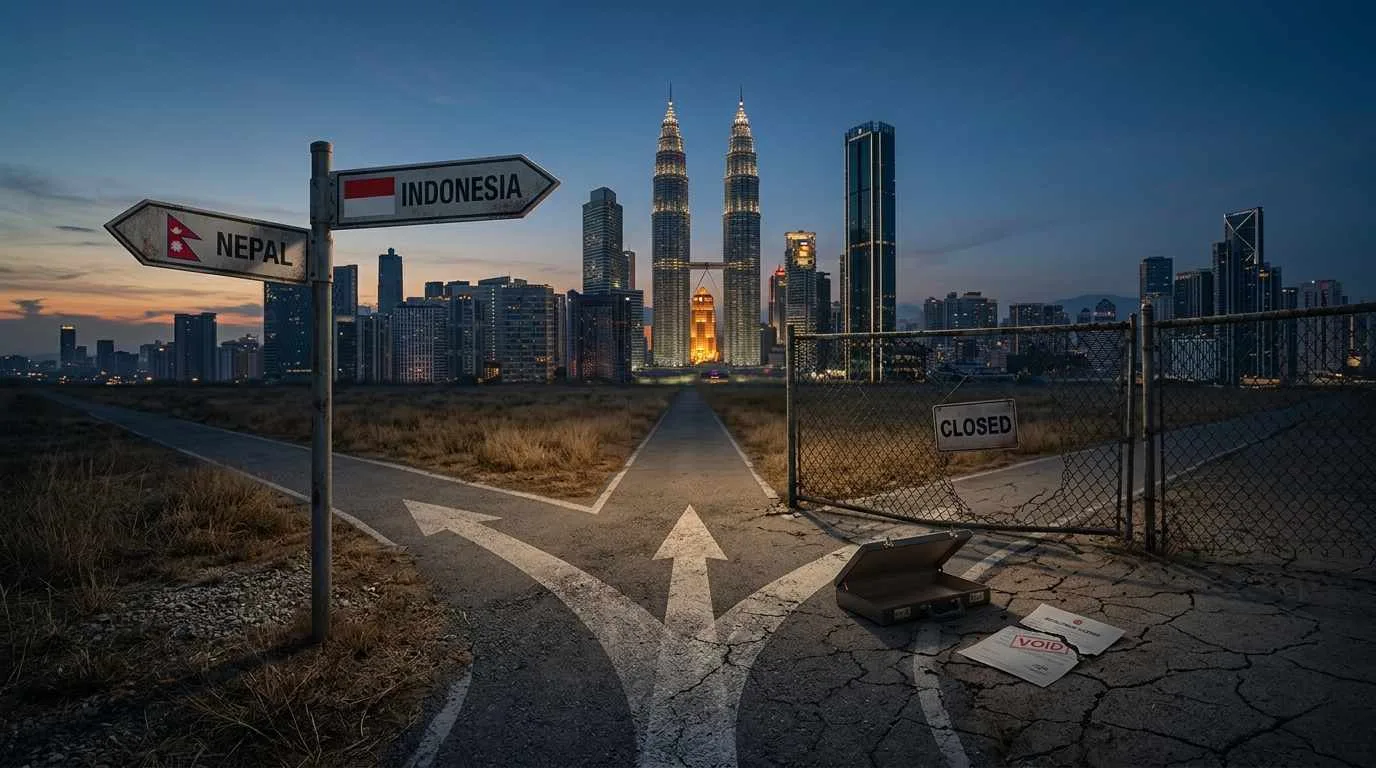
Bangladesh’s window in Malaysia’s labor market is closing fast — and Dhaka may not be moving quickly enough to stop it. The country’s previously approved pool of 100 Malaysia-bound recruitment agencies has effectively collapsed under mounting legal and investigative pressure, creating a structural vacuum at a critical juncture. Malaysia is preparing to reopen its labor market, and if Bangladesh cannot field a functional, compliant recruitment infrastructure in time, Nepal and Indonesia stand ready to fill that gap — permanently.
The Three Fault Lines
Agency Pool Collapse
The entire framework of 100 Malaysia-approved Bangladeshi recruitment agencies has come undone under legal scrutiny and active investigations, leaving the migration pipeline without a functioning operational base.
Malaysia’s Market Reopening
Malaysia is gearing up to reopen its labor market — a significant demand event. The timing is critical: whichever country has a compliant, ready infrastructure will secure long-term placement contracts.
Nepal & Indonesia’s Readiness
Both Nepal and Indonesia maintain active, organized recruitment ecosystems. They are structurally prepared to step in and capture the labor demand Bangladesh is currently unable to serve.
A Permanent Loss Risk
Unlike temporary disruptions, losing footing at the moment of Malaysia’s market reopening could result in Bangladesh being structurally sidelined from this corridor for years to come.
How the Crisis Unfolded
Phase 1 — Approval
Bangladesh secured a pool of 100 recruitment agencies authorized to send workers to Malaysia, establishing one of its most important formal labor migration corridors.
Phase 2 — Legal & Investigative Pressure
Agencies within the approved pool came under legal action and official investigations, systematically eroding the operational capacity of Bangladesh’s Malaysia-bound migration infrastructure.
Phase 3 — Structural Vacuum
The combined effect of these pressures has caused the agency pool to effectively collapse, leaving Bangladesh without a viable recruitment mechanism at precisely the wrong moment.
Phase 4 — The Critical Window
Malaysia moves toward reopening its labor market. Nepal and Indonesia, unencumbered by equivalent disruptions, are positioned to absorb the demand Bangladesh can no longer meet — potentially locking in long-term advantage.
Country Readiness Comparison
| Country | Recruitment Infrastructure | Current Status | Malaysia Positioning |
|---|---|---|---|
| Bangladesh | 100-agency pool (collapsed) | Under legal & investigative pressure | At serious risk of exclusion |
| Nepal | Active & organized | Operational | Ready to absorb demand |
| Indonesia | Active & organized | Operational | Ready to absorb demand |
The question for Dhaka is no longer theoretical. Malaysia’s labor market reopening represents a finite opportunity — one measured in weeks and months, not years. Bangladesh’s historical presence in this corridor was built over decades of migration, remittance flows, and bilateral agreements. Allowing that foothold to erode through administrative and legal paralysis would represent a strategic failure with long-term economic consequences for millions of prospective migrant workers and their families.
Swift, coordinated government action to reconstitute a compliant and functional recruitment framework is the only path to preserving Bangladesh’s place in this market. The window is open — but Nepal and Indonesia are already standing at the door.